Inside the Falcon How CrowdStrike Catches You
A full reverse-engineering teardown of the CrowdStrike Falcon sensor: the six kernel callback sources, the WFP network engine, the file-system minifilter, the cspcm4 broker, the user-mode service (DNS / AMSI / browser / Identity Protection), and the cloud-loaded detection engine — plus every structural blind spot. How Falcon sees you, and where the seams are.
Section 1 The Components
Kernel-mode
lets see whats Driver There used
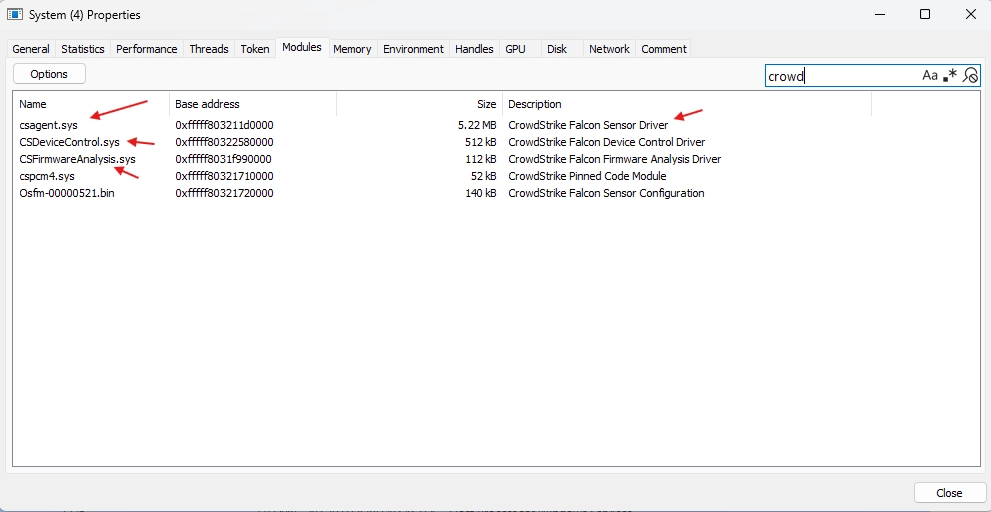
user-mode
they used
- CSFalconService.exe
- CSFalconContainer.exe

csagent.sys Reverse
import Dll From csagent.sys
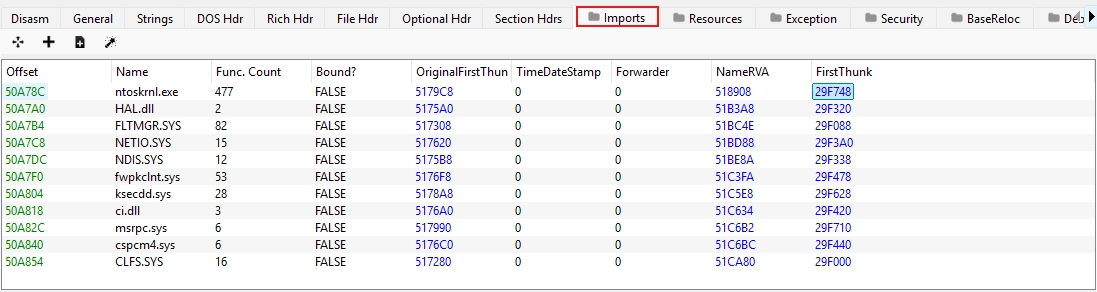
we can see here 5 important sys
1- FLTMGR.SYS ⇒ its mean Registered minifilter driver to can see all operation file system like Create or Delete ,Ex :kernel-mode APIs FltRegisterFilter, FltStartFiltering, FltGetFileNameInformation

2- NETIO.SYS ⇒ used for lower-level network stack to handle the network packets and give him visibility on network traffic
3- fwpkclnt.sys ⇒ is the WFP kernel client 53 imports means csagent.sys has a full network filtering engine that can inspect, block, and modify connections across all layers (transport, network, ALE), giving it firewall-like capabilities to monitor DNS queries and kill C2 traffic.
4- CLFS.SYS ⇒ its a transactional logging; buffers telemetry locally in crash-safe logs and flushes to cloud when connected.
5- cspcm4.sys ⇒ CrowdStrike’s own Pinned Code Module; 6 imports used for internal anti-tamperand sensor code integrity protection.
Reverse main csagent.sys
Lets see For Example PsSetCreateProcessNotifyRoutineEx

the process-notify import we pivot on: PsSetCreateProcessNotifyRoutineEx.
Cross Ref
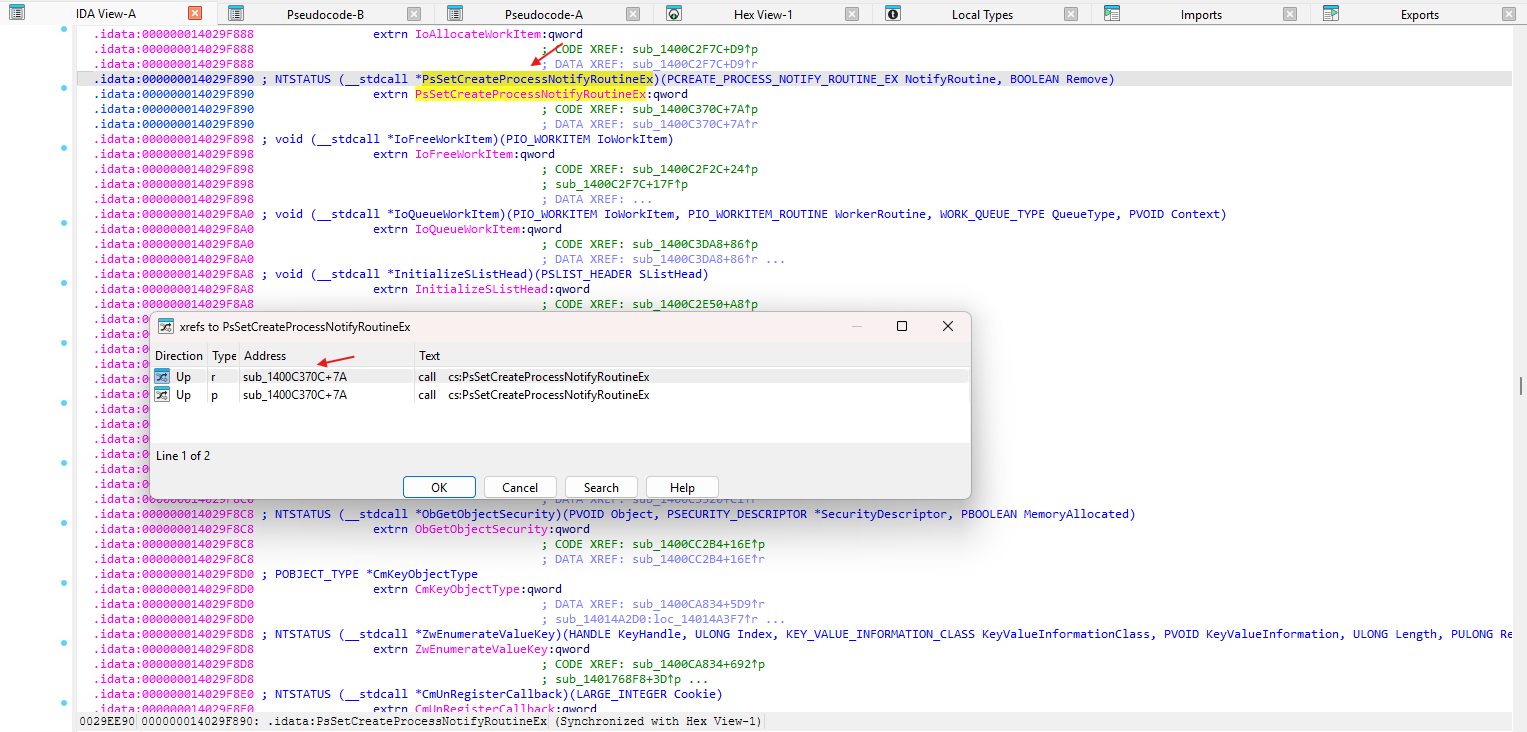
cross-references to PsSetCreateProcessNotifyRoutineEx where the callback gets registered.
if not found will do a fallback on PsSetCreateProcessNotifyRoutineEx
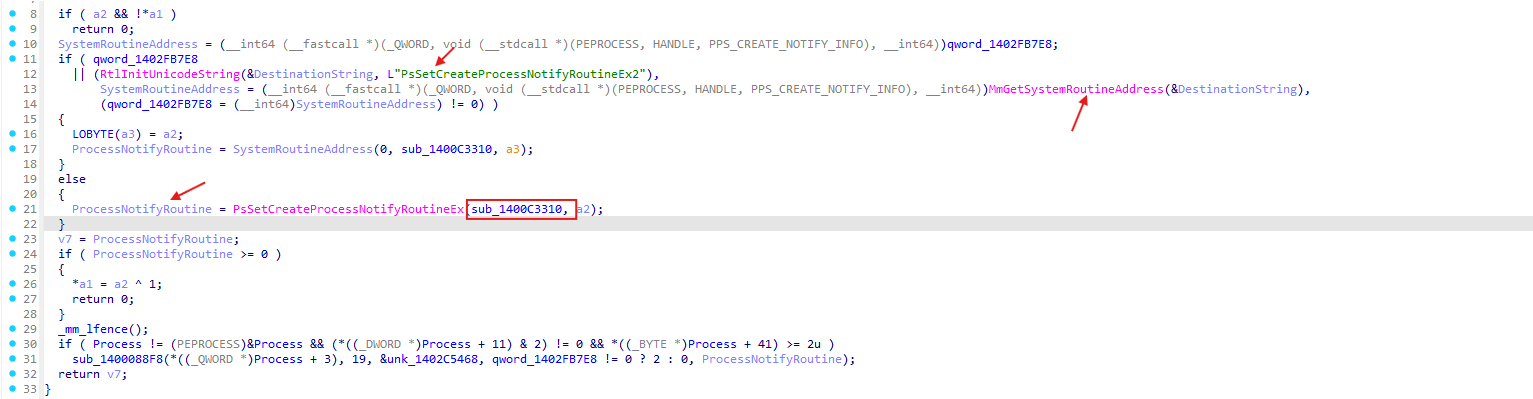
the driver resolves PsSetCreateProcessNotifyRoutineEx2 dynamically via MmGetSystemRoutineAddress, falling back to the Ex variant.
anyway the Callback Functio register in nsub_1400C3310 ⇒ CS_ProcessNotifyCallback

the registered callback sub_1400C3310 (CS_ProcessNotifyCallback) a thin wrapper into the real handler.
good we now got some Spicy function lest first analysis all in sub_1400C3320 than Deep Dive in our Function.
Process Creation

process-creation branch: non-NULL CreateInfo (a4) → sub_1400C39A8 allocates the internal tracking record.
a4 is a CreateInfo if not Null That’s Mean process creation
sub_1400C39A8 do a allocate for internal process tracking record and Fill in the data for the new process and Return to V17
Process Termination
sub_1400C3BEC ⇒ CS_GetExistingProcessRecord
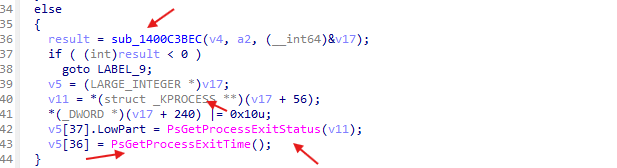
termination branch: CS_GetExistingProcessRecord marks the record terminated and records exit status/time.
sub_1400C3BECretrieves the existing internal tracking record for the terminating process.- extracts the KPROCESS pointer from record offset 56.
- sets flag
0x10at offset 240 marks the record as “terminated.” PsGetProcessExitStatusstores the process exit code into the record.PsGetProcessExitTimestores the exact termination timestamp.
Process Blocking
sub_1400C3DA8 ⇒ CS_ReleaseProcessRecord
if (v18 < 0) → *(a4 + 64) = v18 this is the critical line. Offset 64 in CreateInfo is the CreationStatus field. If the detection engine returns a negative NTSTATUS in v18, it’s written here, which blocks the process from being created this is CrowdStrike’s process-kill mechanism.
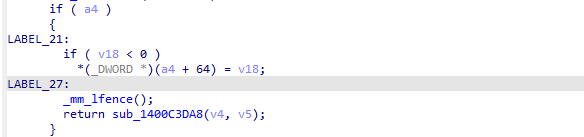
the kill mechanism: a negative NTSTATUS written to CreateInfo+64 (CreationStatus) blocks the process from ever starting.
Event Dispatch
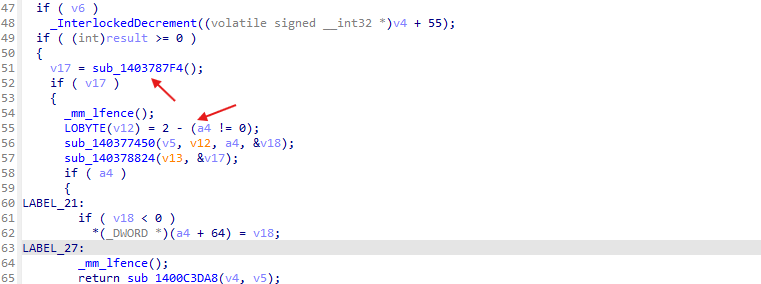
event dispatch: acquire context, compute event-type ID (1=create, 2=terminate), call the detection/dispatch path.
sub_1403787F4acquires event processing context; non-null return means the detection engine is ready.2 - (a4 != 0)computes event type ID: 1 = creation, 2 = termination.sub_140377450main detection/event dispatch; takes process record, event type, and CreateInfo, writes verdict to v18.sub_140378824likely telemetry submission or event completion callback.
Deep Dive
Now lets Jump into theses 2 function
1- sub_1400C39A8 (CS_AllocProcessRecord) ⇒ what it’s gathering about the new process.
the main function to get info about process it sub_1400C42F4 we found it into sub_1400C39A8 (CS_AllocProcessRecord)

inside CS_AllocProcessRecord: the call to sub_1400C42F4 (CS_GetProcessImagePath) that gathers the new process’s image path.
lest jump into sub_1400C42F4(CS_GetProcessImagePath)
we can see here if the process id is 4 which is system process Return 0xC0000225LL ⇒ STATUS_NOT_FOUND

PID 4 (the System process) short-circuits with STATUS_NOT_FOUND (0xC0000225) skipped entirely.
now
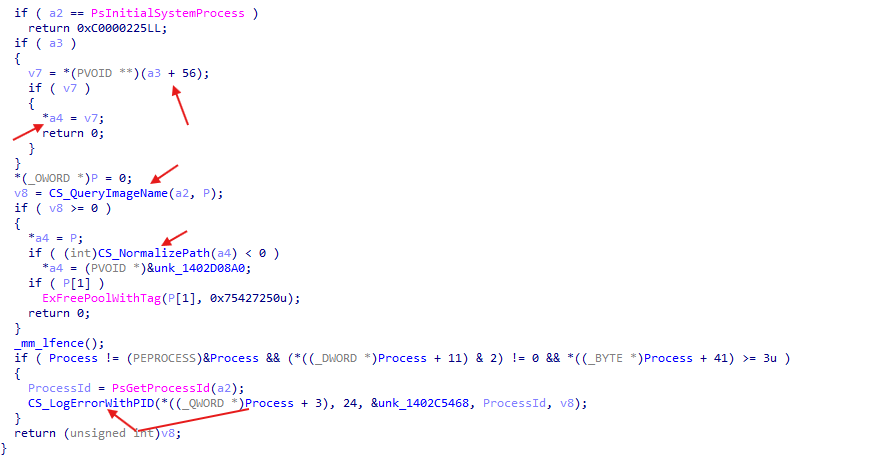
CS_GetProcessImagePath: fast path grabs FileObject from CreateInfo; slow path calls CS_QueryImageName + CS_NormalizePath.
- Fast path if CreateInfo (
a3) exists, grabs the FileObject at offset 56 (the process image .exe path) and returns immediately. - Slow path fallback if fast path unavailable, calls
sub_1403AE624=> **CS_QueryImageName**to manually retrieve the image path from KPROCESS (likely viaSeLocateProcessImageName). - On success,
sub_1400DAB54 => **CS_NormalizePath**validates/normalizes the path; if validation fails, falls back to default descriptorunk_1402D08A0(“unknown source”) rather than failing. ExFreePoolWithTag(P[1], 'uBRp')frees the temp buffer used for image name retrieval; prevents memory leak.- If slow path also fails, logs error (code 24) with the PID via
PsGetProcessIdand reports to cloud telemetry.
so This function retrieves the process image path via two strategies: fast path from CreateInfo directly, falling back to a manual slow path if unavailable and skips the System process entirely.
2- sub_140377450(CS_DetectionDispatch) ⇒ Detection logic (full treatment in Section 8)
Sensor & Engine Checks
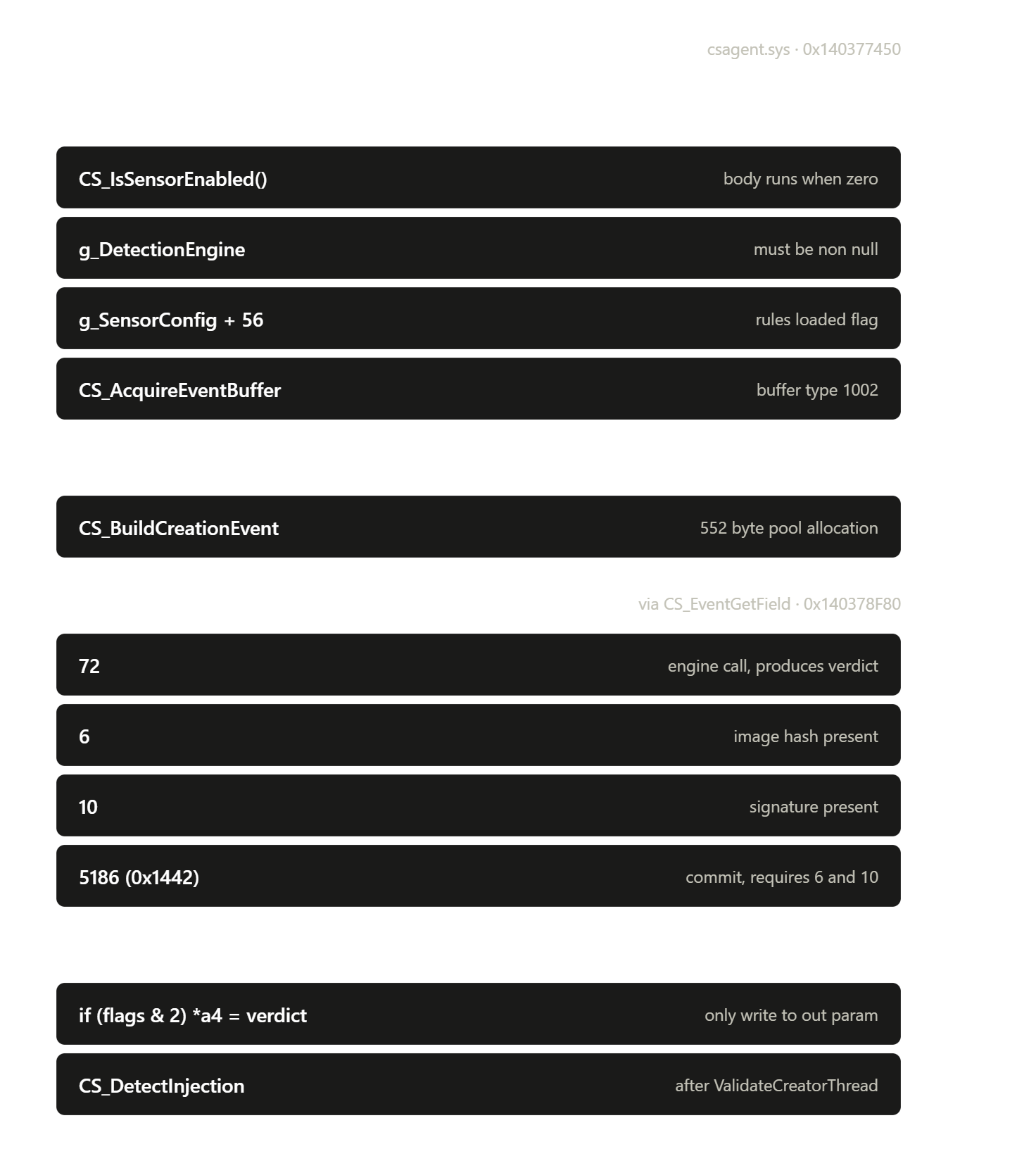
CS_IsSensorEnabled()if non-zero, sensor is disabled; process passes through unchecked.if (!g_DetectionEngine)if null, engine not yet initialized (early boot). Logs error 10 and exits. All early-boot processes pass through unmonitored.- checks
g_SensorConfigoffset 56 if zero, engine not ready (still loading rules). Exits. CS_AcquireEventBuffer(1002)requests process event buffer. If fails → logs error 11, process passes with no detection or telemetry.- event metadata setup:
2097872(event flags),0x10003E9(event type ID).
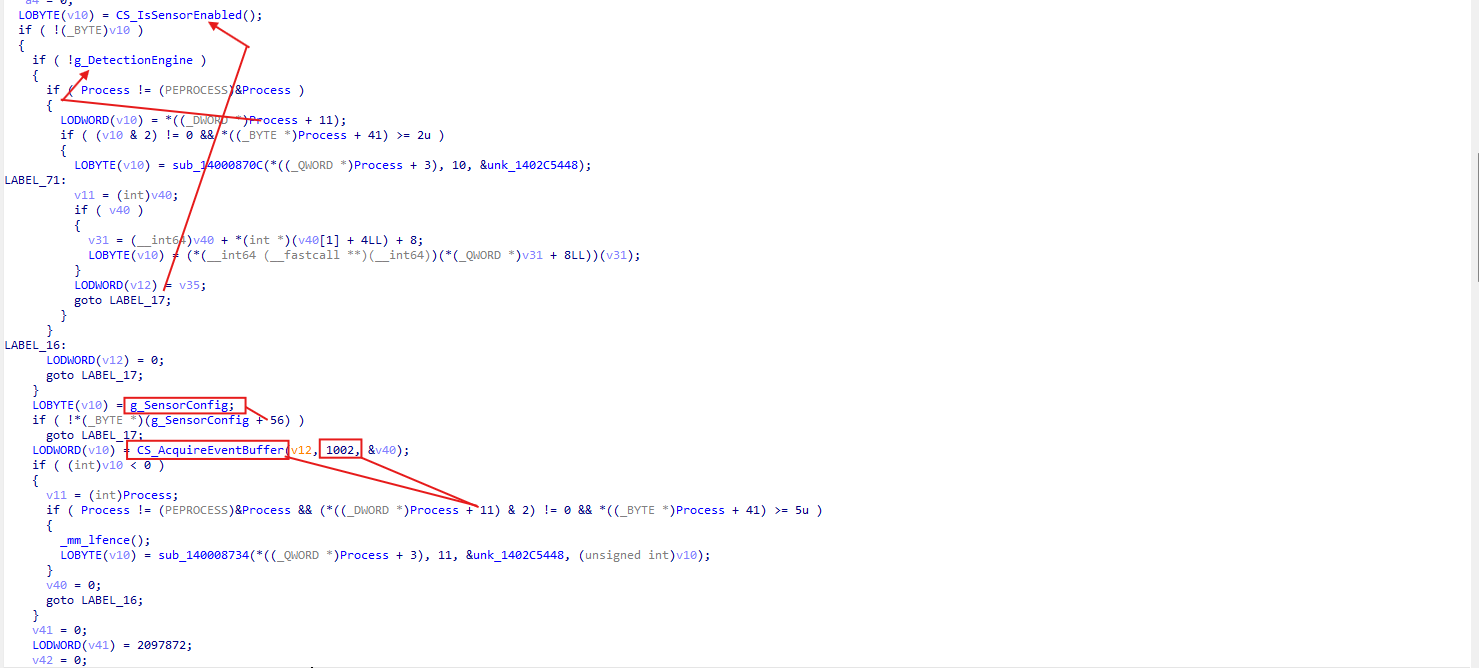
the early gates: CS_IsSensorEnabled, g_DetectionEngine, g_SensorConfig+56, CS_AcquireEventBuffer any failure passes the process through unchecked.
Creation Path
CS_AllocPoolBuffer(552)allocates 552 bytes for the creation event structure.CS_BuildCreationEventbuilds the full event: PID, parent PID, image path, command line, signing, reputation, file flags. (Section 2.)- computes
v9= event object pointer (+32 to reach the primary vtable interface). (*(v9+8))(v9, 72)vtable call with 72 = populate/enrich the event with additional data.- vtable calls with parameters 6 and 10:
- 6 → likely image hash/fingerprint
- 10 → likely behavioral signature pointer
- If both present → calls with 5186 = full detection rule matching (compares against cloud-loaded IOCs and rules).
- if either missing → event cleanup,
v9 = 0, logs error 14 (“incomplete data, skipping detection”).
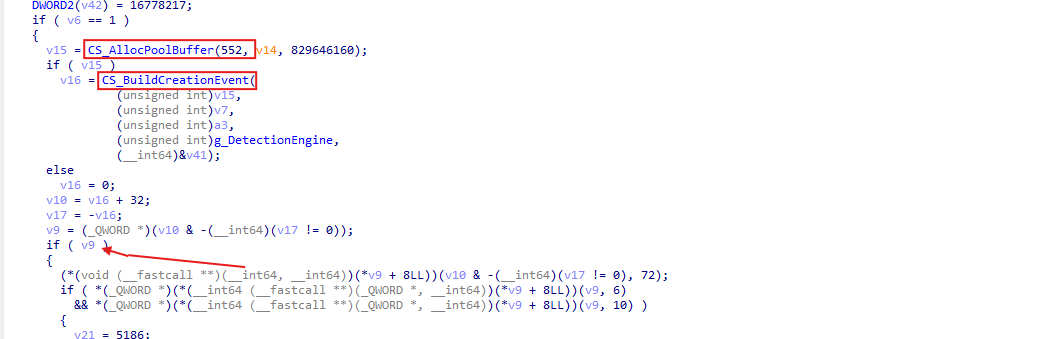
the creation path: 552-byte alloc → CS_BuildCreationEvent → vtable selectors 72/6/10, then 5186 for full rule matching when hash and signature both resolved.
Section 2 Building the Event (CS_BuildCreationEvent)
Binary: CSAgent.sys · Function: CS_BuildCreationEvent @ 0x14037889C
This is the function that actually builds the process-creation event handed to the detection engine. Section 1 saw CS_DetectionDispatch allocate 552 bytes and call this to fill it. Now we open it up.
Signature (as Reversed):
1
2
3
4
CS_BuildCreationEvent(a1 = event buffer (552 bytes),
                      a2 = internal process record,
                      a3 = CreateInfo (PS_CREATE_NOTIFY_INFO),
                      a4, a5)
1. vtable / object setup
First it wires the event up as a COM-like object writes vtable/descriptor pointers into the header:
1
2
3
4
5
6
*(a1 + 8)   = &unk_1402C3C80;
*(a1 + 40)  = &unk_1402C54C0;
*(a1 + 56)  = &unk_1402C3D30;
*(a1 + 544) = &off_1402B3030;
sub_14021DE90(a1, 134218483, g_DetectionEngine);   // register event, type ID 0x80002F3*(a1)   = off_1402B5688;   // primary vtable
*(a1+32)= off_1402B55F0;   // secondary interface
So the event is a polymorphic object with 4 interface pointers. g_DetectionEngine is the global engine handle same one we keep seeing. 0x80002F3 is the event type ID for “process create”.

CS_BuildCreationEvent wires the event as a COM-like object: 4 interface pointers + type ID 0x80002F3 (“process create”).
2. pull the core fields from the process record
a2 is the internal process tracking record (the one CS_AllocProcessRecord built). This block copies the interesting stuff into the event:
1
2
3
4
5
6
7
CS_RefProcessRecord(a2);                       // sub_1400C4784  refcount++ on a2+48
*(a1 + 416) = a2;                              // keep a back-pointer to the record
*(a1 + 240) = *(a2 + 64);                      // PID
*(a1 + 336) = *(a2 + 88);                      // parent PID / session
*(a1 + 296) = CS_ResolveProcessImageInfo(a2);  // sub_1400C4DA0  image path (lazy+cached)
*(a1 + 304) = CS_ResolveProcessCmdInfo(a2);    // sub_1400C4DF8  command line (lazy+cached)
*(a1 + 500) = *(a2 + 212);                     // flags
Ref-count bump first (CS_RefProcessRecord) the event holds a reference so the record can’t be freed underneath it while in flight. Image path / command line use a lazy pattern: cached flag set → return cached pointer; else allocate a node, fill, submit telemetry, cache. Computed once, reused.

refcount bump, then the core fields copied from the process record into the event: PID, parent PID, image path, command line, flags.
3. token / security context
1
2
3
v10 = CS_GetProcessSecurityInfo(a2);           // grabs the token object
if ( CS_GetProcessTokenInfo(a2, a1 + 424) < 0 )  // sub_1400C4F78  SID / integrity
    *(a1 + 424) = 0;

CS_GetProcessTokenInfo resolves the user SID / integrity level into +424 how the sensor knows who ran the process.
CS_GetProcessTokenInfo walks a rundown-protected token reference and resolves the user SID / integrity level into +424. That’s how the sensor knows who ran the process (SYSTEM vs normal user vs elevated). Then two vtable calls into the engine enrich signing info:
1
2
(**g_DetectionEngine)(engine, 8, PID, *(a2+128), a1 + 312);  // signer / cert chain
(**g_DetectionEngine)(engine, 9, PID, *(a2+136), a1 + 320);  // reputation / hash
Selector 8 = signing/certificate lookup, 9 = reputation/hash. Both keyed by PID + a record field. If either fails, the field is zeroed (event still ships).

two engine vtable calls: selector 8 = signer/certificate chain, selector 9 = reputation/hash. Failure zeroes the field; event still ships.
4. PID as a string
1
2
3
*(a1 + 282) = 18;                              // UNICODE_STRING max len
*(a1 + 288) = a1 + 256;                        // buffer inside the event
RtlIntegerToUnicodeString(*(a2 + 64), 10, a1 + 280);  // PID -> decimal string
Renders the numeric PID into a decimal Unicode string stored inline at +256. Cloud rules / telemetry like the PID both as int and text.
5. extra string fields (SID string, integrity string)
1
2
3
sub_140168140(a1 + 488, &v25);   // -> +488 (object) / +496 (byte flag)   err 11
sub_140167E00(v10, 0, a1 + 504, 0);            // token   -> +504           err 12
sub_140167E00(0, *(a2 + 72), a1 + 512, 0);     // record  -> +512           err 13
CrowdStrike never fails event construction on a missing sub-field it zeroes it and moves on. Telemetry is best-effort.
6. file/transaction flags (a nice one)
1
2
3
4
5
6
v15 = *(a3 + 40);                              // FileObject from CreateInfo
if ( v15 ) {
    if ( IoGetTransactionParameterBlock(v15) ) *(a1+520) |= 1;   // launched inside a TxF transaction
    if ( *(*(a3+40) + 75) )                     *(a1+520) |= 2;   // FileObject flag bit
    if ( !*(*(a3+40) + 77) )                    *(a1+520) |= 4;   // FileObject flag bit
}
- bit 1 image file is part of an active transaction (
IoGetTransactionParameterBlock). Classic process doppelgänging / TxF-launch detection malware maps an image from inside a transaction that later rolls back. Flagged right here. - bit 2 / bit 4 two
FILE_OBJECTflag bytes (offsets 75 / 77), likely write-access / delete-pending state.

file/transaction flags at +520: bit 1 = image launched inside a TxF transaction (process doppelgänging), bits 2/4 = FILE_OBJECT state.
7. final enrichment + name validation
1
2
3
4
5
6
7
8
9
10
11
if ( *(a1+424) && v10 && (v16 = sub_140025560(), v17(…, v10, a1+296, a1+304, v16, &v26)) )
    *(a1 + 528) = v26;                         // final verdict/context handle
if ( (*(a2 + 240) & 8) != 0 )
    *(a1 + 528) |= 0x20;                       // record already flagged bit
if ( *(a2 + 248) ) {                           // short name present?
    *(a1 + 432) = *(a2 + 248);                 // copy UNICODE_STRING
    RtlDuplicateUnicodeString(3, a1+432, a1+472);   // deep-copy the name
    if ( sub_1403AE7AC(a1+472) >= 0 )               // CS_NormalizePath-style validation
        *(a1 + 432) = *(a1 + 472);
}
ObfDereferenceObject(v10);                     // drop the token ref
If we have both a token and a resolved SID, a final engine call stores a context handle at +528. Then it validates and deep-copies the process short-name so the event owns its own string copy, and drops the token reference from step 3.
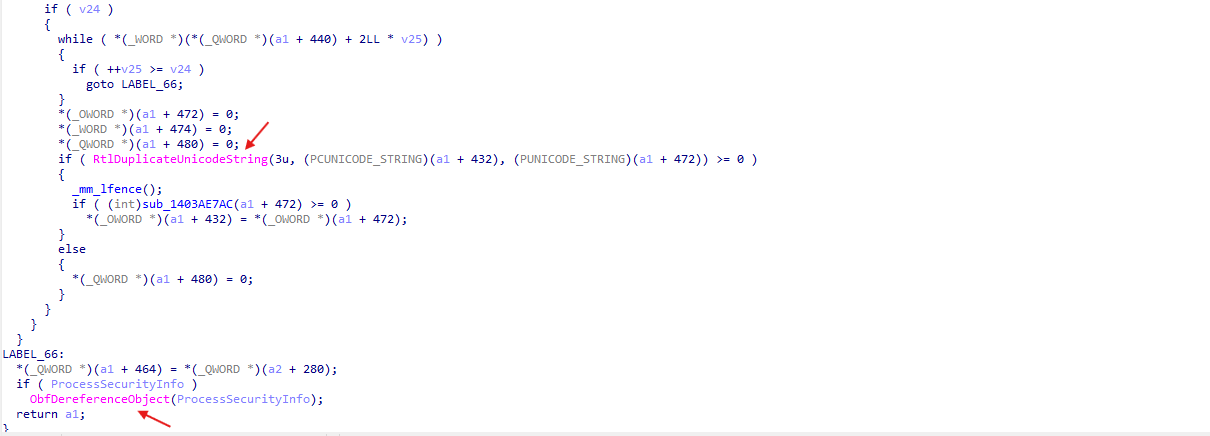
final engine call stores a verdict/context handle at +528, then deep-copies the process short name so the event owns its own string.
Event layout recovered
| Offset | Field |
|---|---|
| +0, +8, +32, +40, +56, +544 | vtable / interface pointers |
| +240 | PID (int) |
| +256 | PID as Unicode string (inline buffer) |
| +296 | image path (resolved) |
| +304 | command line (resolved) |
| +312 | signer / certificate info (engine selector 8) |
| +320 | reputation / hash (engine selector 9) |
| +336 | parent PID / session |
| +416 | back-pointer to process record |
| +424 | user SID / integrity |
| +432 | process short name (owned copy) |
| +488 / +496 | extra string object + flag |
| +500 | process flags |
| +504 | token-derived string |
| +512 | record-derived string |
| +520 | file/transaction flags (bit1 = TxF/doppelgänging) |
| +528 | final verdict / context handle |
CS_BuildCreationEvent is the sensor’s full process-creation telemetry record: identity (PID/parent/name), provenance (image path, command line, TxF flag), trust (signer, reputation, SID/integrity) everything the cloud rules need.
Section 3 The Kernel Eyes (every callback source)
Binary: CSAgent.sys
csagent.sys registers six kernel notification sources. This is the entire “where detection happens” surface:
| # | Source | Register API | Callback fn | Sees |
|---|---|---|---|---|
| 1 | Process | PsSetCreateProcessNotifyRoutineEx | CS_ProcessNotifyCallback | process create / exit / block |
| 2 | Thread | PsSetCreateThreadNotifyRoutine(Ex) | CS_ThreadCreateCallback | thread create/exit, remote threads |
| 3 | Image | PsSetLoadImageNotifyRoutine | CS_LoadImageCallback | EXE/DLL/driver loads |
| 4 | Object | ObRegisterCallbacks | CS_ObPreOpCallback / CS_ObPostOpCallback | handle opens to process/thread (LSASS) |
| 5 | Registry | CmRegisterCallbackEx | CS_RegistryCallback | registry read/write/delete |
| 6 | File | FltRegisterFilter | (minifilter Section 5) | file create/write/delete |
Plus ETW output: EtwRegister / EtwWriteTransfer telemetry to CSFalconService.exe. All funnel into the same event object + engine.
1. Process (recap)
Covered in Sections 1–2. One-line walk: CS_ProcessNotifyCallback (0x1400C3310) → CS_ProcessEventHandler (0x1400C3320) → CS_DetectionDispatch (0x140377450) → CS_BuildCreationEvent (0x14037889C) → rule engine selector 72. Collected: PID, PPID, image path, command line, SID/integrity, signer, reputation, TxF flag. Kill: negative NTSTATUS → CreateInfo->CreationStatus (+64) → process aborted.
2. Thread creation (remote-thread / injection detection)
Where CrowdStrike catches CreateRemoteThread, thread hijacking, injected APC-style threads.
Walk: CS_RegisterThreadCallback (0x1400D0E34) tries the Ex variant first via a dynamically-resolved pointer (qword_1402FB800), falls back to plain PsSetCreateThreadNotifyRoutine. Then CS_ThreadCreateCallback (0x1400CFE50) the meat.
1
2
3
4
5
6
7
8
9
10
11
12
13
14
15
16
17
18
19
20
21
22
CS_ThreadCreateCallback(ProcessId, ThreadId, Create):
   if (g_TraceEnabled) CS_TraceEnter(...)             // ETW trace begin
   if (KeGetCurrentIrql() != 0) bail                  // must be PASSIVE_LEVEL
   if (KeAreAllApcsDisabled()) bail                   // APCs must be enabled
   CS_AcquireEventBuffer(1002)

   if (Create):                                        // ── THREAD CREATE ──
       PsLookupThreadByThreadId(ThreadId, &Thread)
       IsSystemThread = PsIsSystemThread(Thread)
       if (CS_IsExcludedProcess(cur, curPid, 0x5000023)) bail   // self/allowlist
       CS_GetThreadStartAddress(Thread, &startAddr,…)   // Win32StartAddress
       if (!IsSystemThread && startAddr && !byte_1402FB824):
           ThreadProcess = PsGetThreadProcess(Thread)
           CS_DetectRemoteThread(ThreadProcess, startAddr)   // ★ remote-thread check
       evt = ExAllocatePoolWithTagPriority(0x168, 'Tes1')     // 360-byte thread event
       CS_BuildThreadCreateEvent(evt, ProcessId, ThreadId, startAddr, …)
       submit(evt)
   else:                                                // ── THREAD EXIT ──
       if (CS_IsExcludedProcess(cur, curPid, 36)) bail
       evt = ExAllocatePoolWithTagPriority(0x168, 'Tes2')     // termination event
       CS_BuildThreadTermEvent(evt, ProcessId, ThreadId)
       submit(evt)
CS_DetectRemoteThread compares the thread’s owning process against the creator context. A thread whose start address lands in a different process than the caller = classic CreateRemoteThread injection. Fires only when: not a system thread, has a resolved start address, and byte_1402FB824 (config flag) is set.
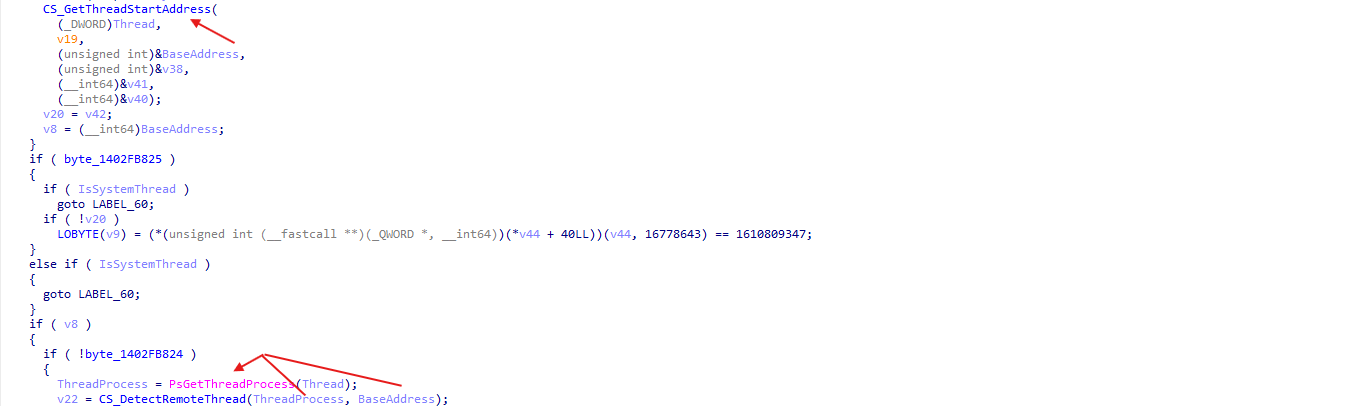
CS_ThreadCreateCallback entry: PASSIVE_LEVEL / APC guards, then the thread-create vs thread-exit split.

CS_DetectRemoteThread: start address in a different process than the caller = classic CreateRemoteThread injection.
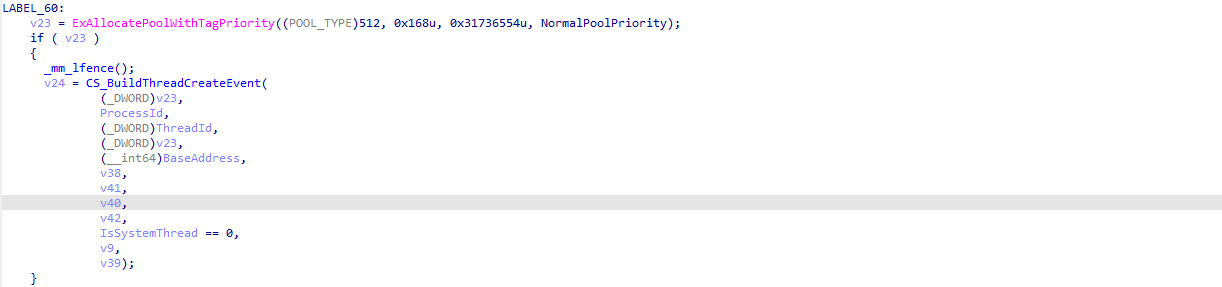
the 360-byte thread event (‘Tes1’) built and submitted with ProcessId, ThreadId and the resolved start address.
3. Image / DLL / driver load
Walk: CS_RegisterImageCallback (0x1400B13E0) → CS_LoadImageCallback (0x1400B03A0).
1
2
3
4
5
6
7
8
9
10
11
12
13
14
CS_LoadImageCallback(FullImageName, ProcessId, ImageInfo):
   if ((ImageInfo->Properties & 0x400) == 0) bail       // need extended IMAGE_INFO
   isKernelImage = (ImageInfo->Properties >> 8) & 1      // SystemModeImage bit
   CS_AcquireEventBuffer(1002)
   if (isKernelImage):                                   // ── DRIVER LOAD ──
       CS_HandleDriverLoad(pid, pid, FileObject, characteristics)
   else:                                                 // ── USER IMAGE ──
       nt = RtlImageNtHeader(imageBase)                  // parse PE
       collect: Characteristics, DllCharacteristics, Subsystem, Machine, SubsystemVersion
       if (imageBase == PsGetProcessSectionBaseAddress(cur)   // MAIN EXE
           && !KeAreAllApcsDisabled() && !KeIsAttachedProcess()):
              CS_HandleMainImageLoad(...)
       CS_DispatchImageEvent(qword_1402FB7A0, pid, FileObject, characteristics)  // ★ event
   CS_SubmitImageDetection(engineCtx, {2, curPid, curTid, ProcessId})
- Driver loads are first-class (
CS_HandleDriverLoad) this is BYOVD (bring-your-own-vulnerable-driver) visibility. Separate path from user images. - Main-image detection compares loaded image base to
PsGetProcessSectionBaseAddresscorrelates image-load to process-create. PE header parsed in kernel (
RtlImageNtHeader) → characteristics/subsystem/machine become telemetry. Malformed PE = interesting fuzz target.
RtlImageNtHeader parses the PE in kernel; Characteristics / DllCharacteristics / Subsystem / Machine become telemetry (a fuzz surface).


kernel images take a first-class branch (CS_HandleDriverLoad) bring-your-own-vulnerable-driver visibility.
4. Object callbacks (LSASS / credential-theft shield)
The single most security-relevant callback what stops mimikatz-style OpenProcess(PROCESS_VM_READ, lsass) dumping.
Walk: CS_RegisterObjectCallbacks (0x1400C1DE8) registers pre-op CS_ObPreOpCallback + post-op CS_ObPostOpCallback for both PsProcessType and PsThreadType. → CS_ObPreOpCallback (0x1400C20D0) → CS_CheckHandleAccess (0x1400C2234), the actual decision.
1
2
3
4
5
6
7
8
9
10
11
12
13
14
15
16
CS_ObPreOpCallback(reg, opInfo):
   if ( ExGetPreviousMode()                       // request came from USER MODE
     && (opInfo->Flags & 1) == 0                   // real op (not kernel handle)
     && ( opInfo->Operation is CREATE(1)/DUPLICATE(2)
       && !CS_CheckHandleAccess(ObjectType, TargetProcess, DesiredAccess) ) ):
         reg->callback(reg, opInfo)                // → strip/deny logic

CS_CheckHandleAccess(type, targetProc, access):
   if (type == PsProcessType)  harmless = (access & 0xFFEDCFFF) == 0;
   if (type == PsThreadType)   harmless = (access & 0xFFEDF3FF) == 0;
   if (harmless) return 1;                          // allow, no stripping
   if (CS_GetHandlePolicy(...) ok && policy < 0x3000):
        if (targetProc == IoGetCurrentProcess()     // opening a handle to YOURSELF
            || threadOwner == PsGetCurrentProcessId()):
              return 1;                              // self-access always allowed
   return 0;                                         // → strip access
- Process mask
0xFFEDCFFFcleared bits (~mask = 0x00123000) are the only “harmless” ones.PROCESS_VM_READ/WRITE/OPERATION,CREATE_THREAD,DUP_HANDLE,TERMINATEall trip the check. - Thread mask
0xFFEDF3FFsame forTHREAD_SET_CONTEXT,SUSPEND_RESUME, etc. - Self-access exception a process opening a handle to itself is always allowed. The escape hatch every EDR needs.

CS_CheckHandleAccess: process mask 0xFFEDCFFF / thread mask 0xFFEDF3FF decide “harmless”; VM_READ/WRITE, CREATE_THREAD, DUP_HANDLE trip the check. Self-access always allowed.
Blind spots: the entire filter is gated on ExGetPreviousMode() == UserMode a kernel-mode actor opening a handle is not filtered here. opInfo->Flags & 1 (kernel handles) skip it. Altitude ordering games. Static masks.
5. Registry
Catches persistence (Run keys), defense tampering, credential access via hives.
Walk: CS_RegisterRegistryCallback (0x1400C8F78) → CS_RegistryCallback (0x1400C7790) → CS_RegistryFilterDispatch (0x1400C7CA8).
1
2
3
4
5
6
7
8
9
10
CS_RegistryCallback(ctx, NotifyClass, Arg2):
   if (ExGetPreviousMode() == KernelMode):            // kernel-origin op
       if (NotifyClass != 47) return 0;               // only RegNtPreDeleteValueKey inspected
   else:                                              // user-origin op
       KeEnterCriticalRegion()
       swap = KeSetKernelStackSwapEnable(0)           // pin kernel stack (anti-recursion)
       if (!recursionGuardSet):
            recursionGuard = 1
            result = CS_RegistryFilterDispatch(ctx, NotifyClass, Arg2)   // ★
            recursionGuard--
- User-mode ops fully inspected; kernel-mode almost entirely ignored only
RegNtPreDeleteValueKey(class 47) is looked at from kernel. SameExGetPreviousMode()trust boundary. - Recursion guard prevents the sensor’s own registry access from re-entering while set, that thread’s ops aren’t re-inspected.

CS_RegistryCallback: kernel-origin ops ignored except RegNtPreDeleteValueKey (class 47); user-origin ops fully inspected.

the recursion-guarded dispatch: KeSetKernelStackSwapEnable(0) pins the stack, guard blocks the sensor’s own registry access from re-entering.
Section 4 The Network Inspector (WFP)
Binary: CSAgent.sys
csagent.sys embeds a full Windows Filtering Platform (WFP) engine connection visibility, DNS/telemetry, and the ability to kill C2 traffic. Imports: fwpkclnt.sys (53 fns) + NETIO.SYS.
The WFP building blocks
| Plane | APIs | Purpose |
|---|---|---|
| Management | FwpmEngineOpen0, FwpmProviderAdd0, FwpmSubLayerAdd0, FwpmFilterAdd0, FwpmCalloutAdd0 | install provider/sublayers/filters |
| Callout (data) | FwpsCalloutRegister2 | the classify functions that inspect each packet |
| Flow context | FwpsFlowAssociateContext0, FwpsFlowRemoveContext0, FwpsFlowAbort0 | per-connection state |
| Stream DPI | FwpsCopyStreamDataToBuffer0, FwpsCloneStreamData0 | deep-inspect TCP payloads (DNS, HTTP, TLS SNI) |
| Injection | FwpsInjectTransportSendAsync1, FwpsStreamInjectAsync0, FwpsInjectionHandleCreate0 | inject/modify/reset packets connection-kill |
| Sockets (WSK) | WskRegister, GetIpForwardTable2, GetIpNetTable2 | the sensor’s own kernel network client + topology |
Not just a monitor provider + sublayers + filters + callouts + injection + its own socket stack. Firewall-grade.
1. Two filtering engines
Walk: CS_RegisterCallouts_Eng1 (0x14020DE50) and CS_RegisterCallouts_Eng2 (0x14021E738) near-identical loops registering callouts against two engine handles:
g_WfpEngine1(0x1402FB328) Eng1 handles layer indices 0–5g_WfpEngine2(0x1402FB370) Eng2 a bitmask of layers (0,1,3,4,6)
Both draw callout descriptors from the same global table (g_CalloutTable 0x1402F9A48, g_CalloutTableCount 0x1402F9A40), built by 11 per-layer functions.
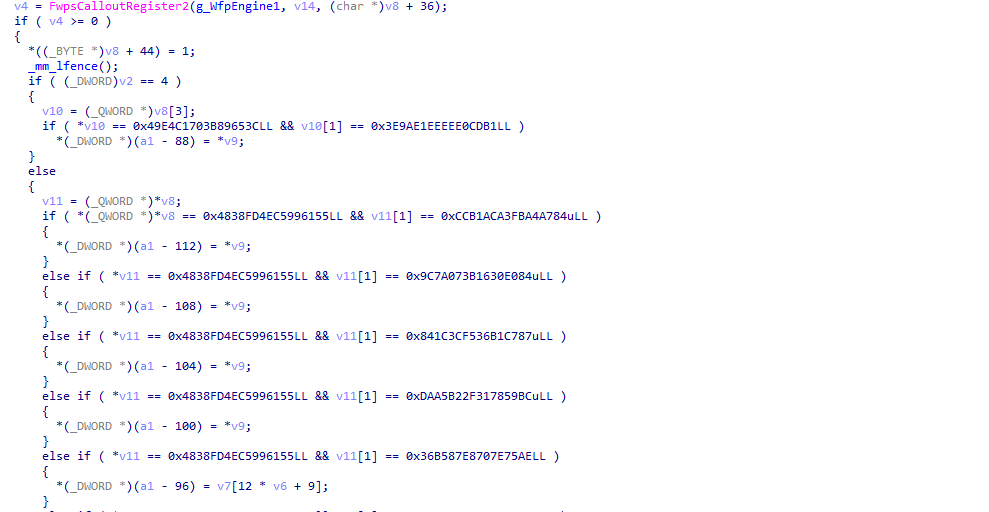
CS_RegisterCallouts_Eng1/Eng2: near-identical loops registering callouts against the two WFP engine handles from a shared callout table.
The callout GUIDs (a real fingerprint)
1
2
3
prefix qword  0x4838FD4EC5996155  (shared by most callouts)
  + 0xCCB1ACA3FBA4A784 / 0x9C7A073B1630E084 / 0x841C3CF536B1C787 …
one different family: 0x49E4C1703B89653C / 0x3E9AE1EEEEE0CDB1  (layer index 4)
Stable host/network fingerprint netsh wfp show state and match these keys.
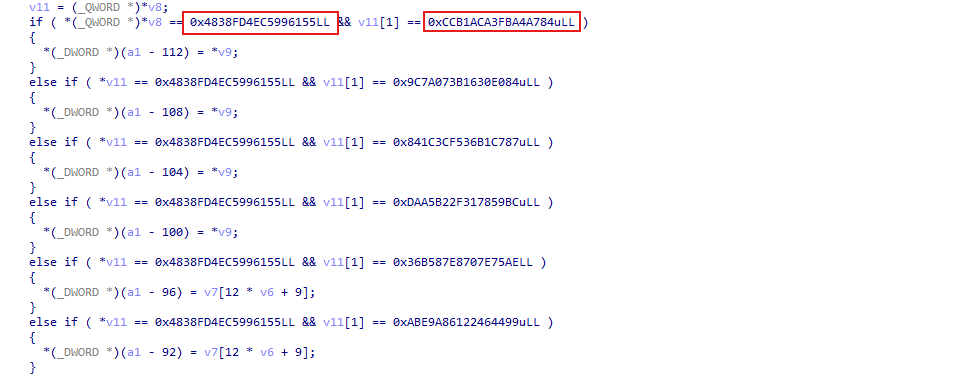
the callout GUIDs (shared prefix 0x4838FD4EC5996155) a stable host/network fingerprint you can match in netsh wfp show state.
2. Connection tracking CS_FlowEstablishClassify (0x1400B5DF0)
When the ALE “flow established” layer fires, this builds a per-flow tracking record:
1
2
3
4
5
6
7
8
9
CS_FlowEstablishClassify(adapterCtx, layerData, numLayers, flowId, ...):
    if (adapterCtx->flowCount < 0x2710) {                    // cap: 10,000 concurrent flows
        rec = CS_AllocPoolSized(NonPaged, size, 'CSFR');     // ← CrowdStrike Flow Record
        rec->flowId = flowId; rec->timestamp = sub_140149C04();
        memcpy(rec->tuple, tupleData, tupleLen);             // the 5-tuple
        for each layer:
            FwpsFlowAssociateContext0(flowId, layerId, calloutId, (UINT64)rec);  // ★ attach
        link rec into adapterCtx->flowList;
    }
FwpsFlowAssociateContext0attaches the record so every packet/stream chunk on that connection is delivered to the callouts with this record as context that’s what makes inspection stateful.- Pool tag
'CSFR'(0x52465343)!poolusedshows one per tracked connection. The 10,000-flow cap is a hard ceiling: beyond it, new flows aren’t tracked.
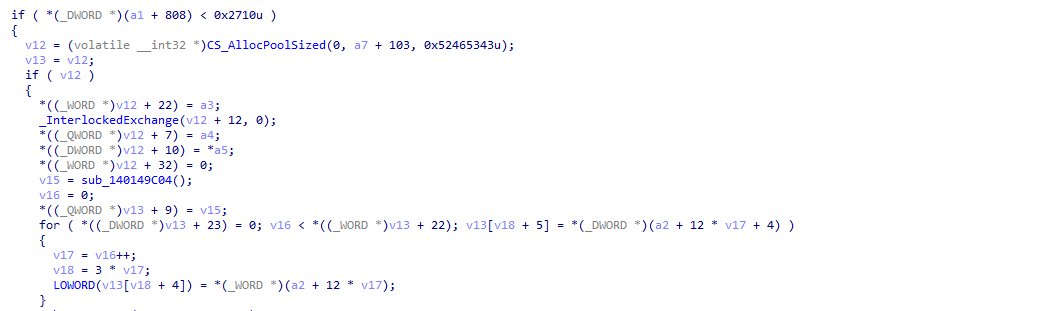
CS_FlowEstablishClassify allocates a per-flow record (pool tag ‘CSFR’) and stores the 5-tuple capped at 10,000 concurrent flows.
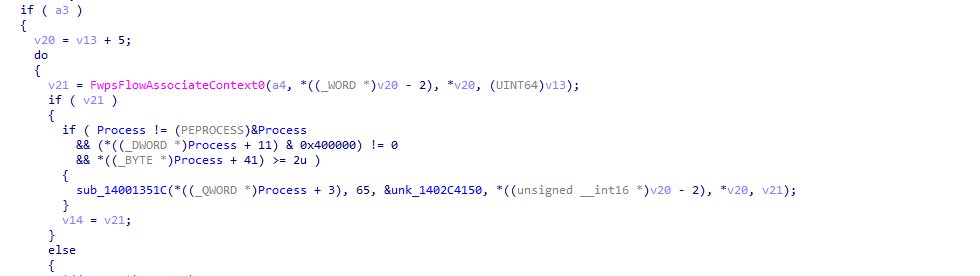
the FwpsFlowAssociateContext0 loop that attaches the record to every layer what makes packet inspection stateful per-connection.
Because the record is associated as flow context, the stream/transport classify callbacks receive it on every packet accumulating per-connection state (bytes, direction, timing), correlating to the owning process (PID from the ALE layers), and handing payloads to DPI with connection identity attached. Connection-oriented, not stateless packet filtering.
3. The action side injection & connection kill
Walk: CS_InjectTransportPacket (0x1401D4260) the transport/stream injector.
1
2
3
4
5
6
7
8
9
CS_InjectTransportPacket(...flowId, proto, ...):
    buf = ExAllocatePoolWithTagPriority(NonPaged, size, 'pPDd')   // tag PdPp
    CS_MemCopy(buf, payload, size)
    mdl = IoAllocateMdl(buf, size); MmBuildMdlForNonPagedPool(mdl)
    FwpsAllocateNetBufferAndNetBufferList0(..., mdl, ..., &nbl)
    if (proto == 6 /* TCP */):
        FwpsStreamInjectAsync0(g_InjHandleStream, …, flowId, …, nbl, size, …)   // TCP stream
    else:
        FwpsInjectTransportSendAsync1(...)                                       // transport datagram
Inject a TCP RST/FIN into a flagged flow → connection dies (C2 kill). Or inject/replace stream data → sinkhole.
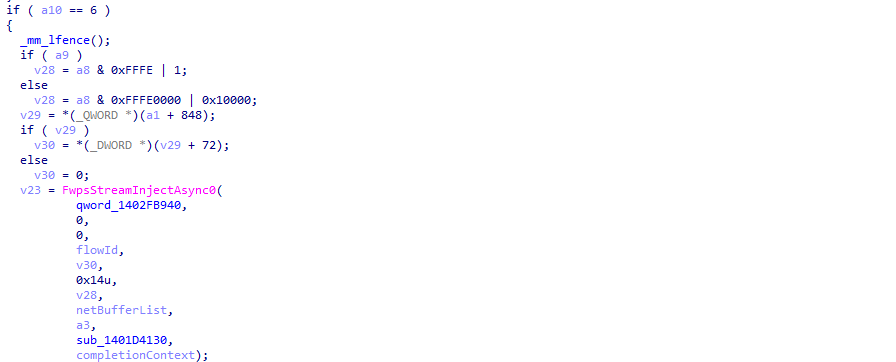
CS_InjectTransportPacket: copies payload into a ‘pPDd’ buffer, builds the MDL + NET_BUFFER_LIST for injection.
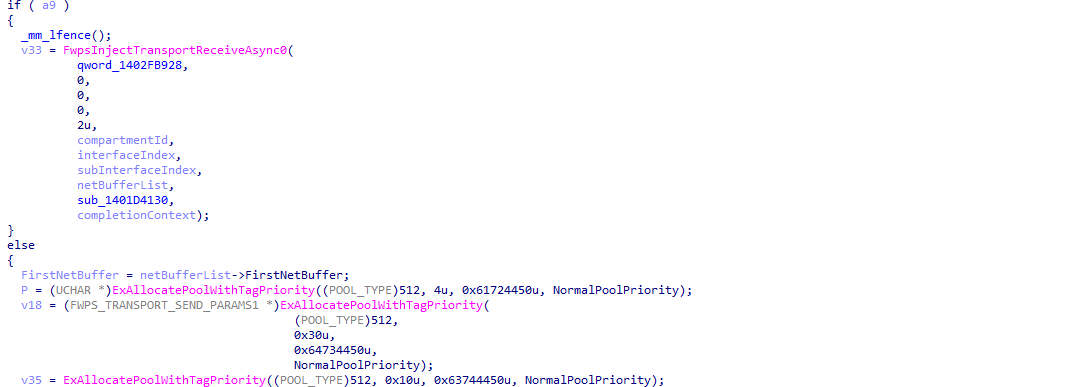
the protocol branch: proto == 6 (TCP) → FwpsStreamInjectAsync0, else FwpsInjectTransportSendAsync1 the connection-kill primitive.
Killing tracked connections CS_KillFlaggedFlows (0x1401D108C)
When the engine flags flows for termination:
1
2
3
4
5
6
CS_KillFlaggedFlows(ctx):
    for (bucket = 0; bucket < flowMgr->count(); bucket++) {
        collect up to 1000 flow ids;                 // bounded batch (0x3E8)
        for each collected flow:
            CS_ResetFlow(ctx, flow, proto=6 /*TCP*/); // → CS_InjectTransportPacket (RST)
    }
CS_ResetFlow (0x1401D626C) calls the injection primitive to inject a TCP reset into the flow. The application just sees its connection drop. That’s the mechanical answer to “how does CrowdStrike kill C2 traffic”: it doesn’t ask the firewall to block it injects a reset into the live flow it’s been tracking.
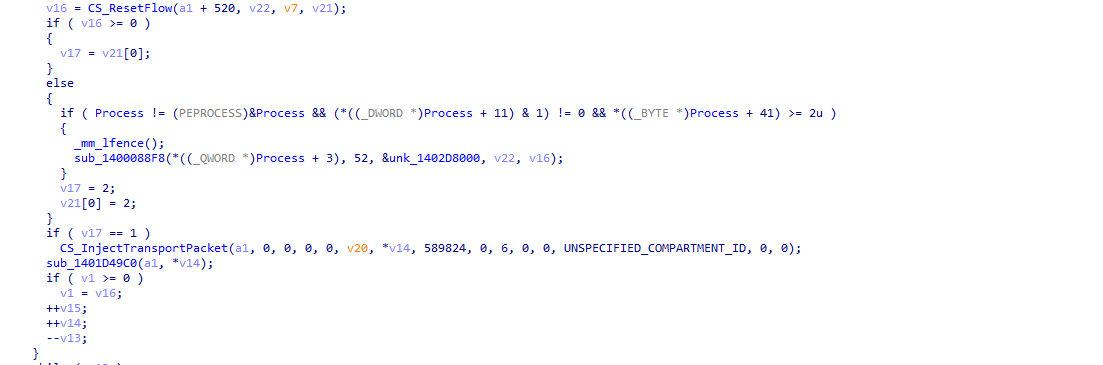
CS_KillFlaggedFlows walks tracked flows in bounded batches and calls CS_ResetFlow → injects a TCP reset. This is how C2 gets killed.
4. The sensor’s own network stack (WSK)
csagent is also a WSK client (WskRegister), plus NETIO topology calls (GetIpForwardTable2, GetIpNetTable2, GetIfEntry2). It can open its own kernel sockets (cloud comms / sinkhole from ring-0) and enumerate/watch network topology (interfaces, routes, ARP) noticing rogue VPNs or new adapters.
Network artifacts: WFP provider + 2 sublayers + many callouts (netsh wfp show state), pool tags CSFR (tracked flows) and PdPp (injected buffers), injection handles, WSK registration.
Section 5 The File System Minifilter (FLTMGR)
Binary: CSAgent.sys
The last major detection class file create/open, write, delete, rename, execution-mapping. Core of ransomware detection, dropper detection, file-based IOC matching.
1. Registration CS_RegisterMinifilter (0x1403630B0)
1
2
3
4
5
6
7
CS_RegisterMinifilter(state):
    Registration = { …, OperationRegistration = 0x1402B4880, FilterUnload = CS_FltUnload, … }
    status = FltRegisterFilter(DriverObject, &Registration, &Filter);
    if ( status >= 0 ) {
        ExInitializeRundownProtection(&RunRef);
        sub_140380440(6, Filter);          // start filtering / attach instances
    }
Runs under a critical region + state machine (dword_140515008: 1=unregistered, 2=registering, other=active) so registration can’t race.

the minifilter registration, guarded by a state machine
2. The operation table what’s watched
The OperationRegistration array at 0x1402B4880 hooks 12 IRP major functions:
| IRP major | Pre-op | Why CrowdStrike cares |
|---|---|---|
IRP_MJ_CREATE | CS_FltPreCreate | every file open/create path, access, disposition |
IRP_MJ_SET_INFORMATION | CS_FltPreSetInfo | rename + delete ransomware trips this |
IRP_MJ_QUERY_INFORMATION | CS_FltPreQueryInfo | metadata queries |
IRP_MJ_CLEANUP | CS_FltPreCleanup | last handle closed |
IRP_MJ_READ | CS_FltPreRead | reads (exfil signals) |
IRP_MJ_WRITE | CS_FltPreWrite | writes ransomware/dropper content |
IRP_MJ_SET_SECURITY | CS_FltPreSetSecurity | ACL tampering |
IRP_MJ_ACQUIRE_FOR_SECTION_SYNC (0xFF) | CS_FltPreAcquireForSection | file mapped for execution |
IRP_MJ_DIRECTORY_CONTROL | CS_FltPreDirControl | directory enumeration |
IRP_MJ_DEVICE_CONTROL | CS_FltPreDeviceControl | IOCTLs |
| (0xF2 fast-io) | FsControl-adjacent | FS-control fast path |
IRP_MJ_FILE_SYSTEM_CONTROL | CS_FltPreFsControl | FSCTLs (reparse, USN) |
Near-total file-system coverage. Most security-relevant: SET_INFORMATION (delete/rename) and ACQUIRE_FOR_SECTION (about to execute/memory-map complements the image-load callback).

12 IRP majors hooked near-total file-system visibility
3. The callback pattern thin trace shim → real handler
Every pre-callback is the same shape (here CS_FltPreCreate, 0x1403622A0):
1
2
3
4
5
CS_FltPreCreate(Data):
    if (g_TraceEnabled & 2)  trace_enter(...);          // ETW/debug, gated
    result = CS_HandleFileCreate(Data);                 // ← the real work
    if (g_TraceEnabled & 2)  trace_exit(..., result);
    return result;                                       // FLT_PREOP_* verdict
Real logic lives in per-op handlers: CS_FltPreCreate → CS_HandleFileCreate (0x1400A2834); CS_FltPreSetInfo → CS_HandleFileSetInfo (0x14009E2F4, delete/rename); CS_FltPreDeviceControl → CS_HandleFileDeviceControl (0x1400A7190). Note g_TraceEnabled & 2 same global as the network layer (& 1), different bit.
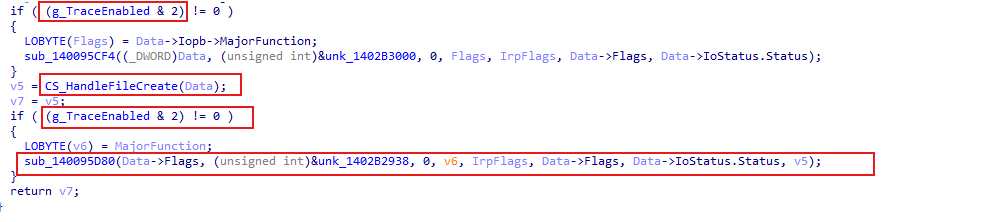
every FLT callback is a thin trace shim around the real handler same pattern as the rest of the sensor
The handler resolves the normalized file path (via FLT_FILE_NAME_INFORMATION), determines the kind of set-info (rename/delete/hardlink), packages it → shared event ring → engine → cloud.
File artifacts: registered minifilter + altitude (fltmc filters), per-volume instances (fltmc instances), ETW/debug trace (bit & 2, usually off).
Section 6 cspcm4.sys, the Pinned Code Module
Binary: cspcm4.sys (imagebase 0x180000000)
Section 1 saw csagent import 6 functions from cspcm4.sys “anti-tamper and sensor code integrity.” Time to open it. It’s tiny 53 KB, 101 functions so we can Reverse essentially all of it.
Verdict up front: cspcm4 is not a scanner. It’s a shared-services broker a resident (“pinned”) module providing a small stable ABI of trusted primitives (memory, callback registry, pinned code page, APC injection) that the rest of the driver family rendezvous with. Kernel glue.
1
2
3
module:      cspcm4.sys   image size 0xD000 (53 KB)   101 functions
exports:     ordinals 800–806 + DllInitialize(807) + DllUnload(808)
imports:     ntoskrnl only  Ex/Ke/Rtl/Mm. No FLTMGR, no crypto, no network.
1. DllInitialize the rendezvous
Walk: DllInitialize (0x180001470). The whole design in one function.
1
2
3
4
5
6
7
8
9
10
11
12
13
14
15
16
17
18
19
DllInitialize():
    CS_InitSecurityCookie();
    if ( KUSER_SHARED_DATA[0x2EC] )  return 0xC000041F;   // boot/debug-state gate: abort
    ObjectAttributes = { name, OBJ_CASE_INSENSITIVE|OBJ_PERMANENT };
    if ( ExCreateCallback(&cb, &oa, Create=0, Allow=0) < 0 )   // try to OPEN existing
    {
        // ---- FIRST loader: we own the module ----
        qword_180005168 = &shared_context;
        CS_PcmInit();
        if ( KUSER_SHARED_DATA[0x330] )  shared[4424] = 0;   // skip pinned-page copy
        else {
            CS_MemMove(shared+328, <current 4KB page>, 4096); // ← COPY THE PINNED PAGE
            shared[4424] = 1;
        }
        ExCreateCallback(&cb, &oa, Create=1, Allow=0);
        ExRegisterCallback(cb, Pcm_BrokerCallback, 0);       // publish ourselves
    }
    else
        ExNotifyCallback(cb, &qword_180005168, 0);           // hand context to the owner
cspcm4 uses a named Ex callback object as a singleton rendezvous. First CS module to init creates the object and publishes a broker callback; later modules just notify the existing object and exchange context pointers. Pcm_BrokerCallback (0x180001010) is trivial: *Argument1 = qword_180005168 whoever calls gets a pointer to the shared context. Classic way for a driver family to share one trusted state block without exporting it by symbol.
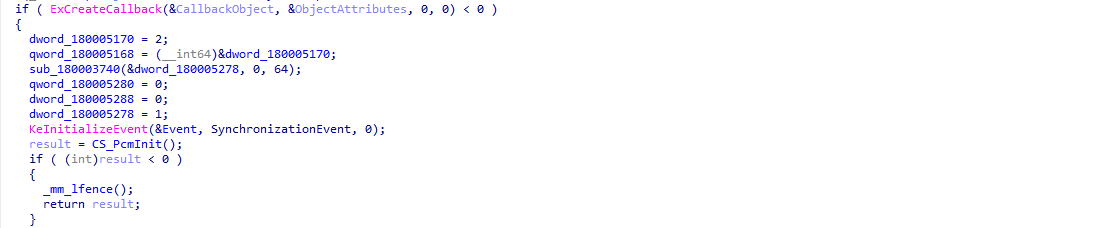
named-callback singleton: first loader owns the context, others rendezvous
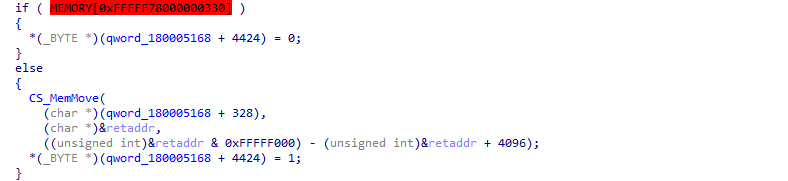
the actual ‘pinned’ 4 KB code page being copied into resident context.
2. The exported ABI (ordinals 800–806)
| Ord | Renamed | Purpose |
|---|---|---|
| 800 | Pcm_AllocPool | pool alloc (NonPaged unless flag) |
| 801 | Pcm_FreePool | pool free |
| 802 | Pcm_RegisterCallbackSlot | register a callback in a 16-slot table |
| 803 | Pcm_ReadPinnedPage | copy the resident 4 KB pinned page out |
| 804 | Pcm_GetContextPtr | return context base |
| 805 | Pcm_RunCleanup | invoke CS_CleanupEntries |
| 806 | Pcm_InitApc | initialize a KAPC for injection |
1
2
3
4
5
6
Pcm_RegisterCallbackSlot(id, fn, &old):     // ord 802  the interesting one
    ExAcquireFastMutexUnsafe(shared+264);
    slot = 0;
    while (table[slot].id != id && table[slot].id != 0 && slot < 16) slot++;
    *old = table[slot].fn;                   // return previous handler
    table[slot].fn = fn;  table[slot].id = id;   // install new handler
A fixed 16-entry {id, fn} table under a fast mutex. Other CS drivers register handlers here by id; the broker dispatches. Pcm_InitApc (0x180001340) wraps KeInitializeApc cspcm4 owns the APC machinery the sensor uses to run code in a target thread’s context.
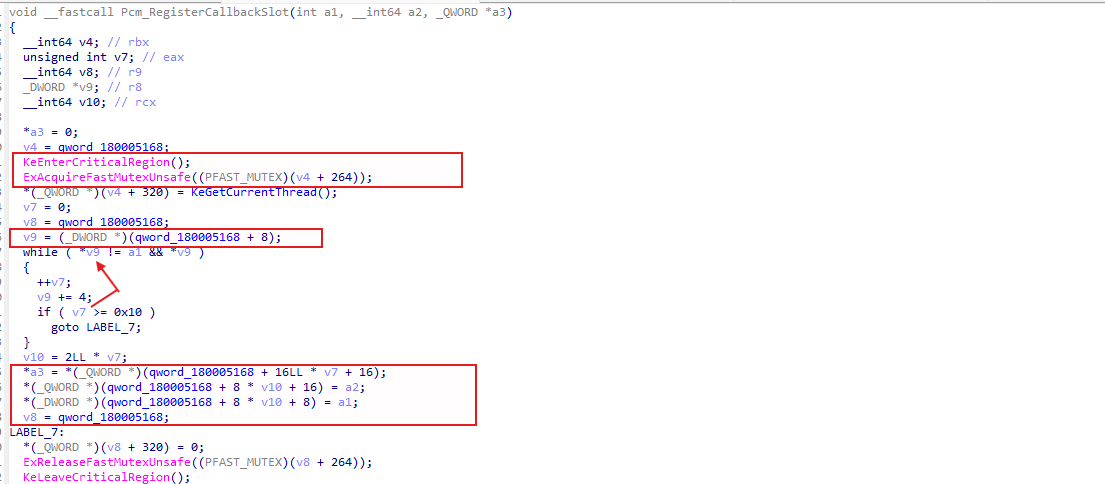
cspcm4’s inter-module callback registry 16 slots
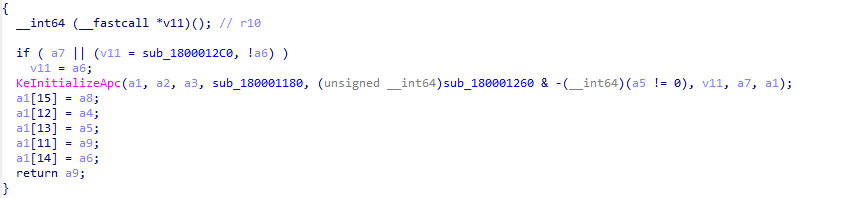
the sensor’s APC-injection primitive lives here.
3. The 6 embedded SHA-1 strings
.rdata holds six 40-char SHA-1 hex strings collected into a pointer array at 0x1800044E0. Honest note: in this module the array has no direct code xref nothing in cspcm4’s .text reads it. That implies the strings are identity/allowlist data consumed elsewhere (read via the pinned page by csagent, or matched by higher-level integrity logic). They look exactly like an allowlist of trusted module SHA-1s but the comparison isn’t performed here.

embedded SHA-1 allowlist data only, compared by the consumer, not here.
Reframe of the anti-tamper picture: cspcm4 is infrastructure, not an active guard. No code here watches csagent’s memory or re-verifies it at runtime. Patching CS_IsSensorEnabled→1 in csagent is not stopped by cspcm4. The real tamper-resistance lives in the user-mode service + ELAM/early-launch, PPL on CSFalconService.exe, and whatever consumes the SHA-1 allowlist. cspcm4 is plumbing, not a wall.
Section 7 User-Mode Detection (CSFalconService.exe)
Binary: CSFalconService.exe (SYSTEM, ~15.5 MB)
The kernel driver is only half the sensor. The other half does what the kernel can’t easily do: DNS analysis, browser-credential-theft detection, PowerShell/script inspection via AMSI, device posture, and Identity Protection (Kerberos/NTLM/LDAP). The service is a modern async C++ actor-model binary (ActivatableClass<...Actor, Actors>) the RTTI class names lay the whole architecture out.



the service’s own type metadata reveals every detection subsystem.
1
2
3
4
5
6
7
8
CSFalconService.exe (SYSTEM)
├── NetworkPolling ......... DNS monitoring
├── AMSI provider .......... PowerShell / script inspection
├── Browser policy ......... Chrome/Edge/Firefox extension + credential monitoring
├── ZeroTrustAssessment .... device posture scoring (data.zta)
├── IdentityProtection ..... Kerberos/NTLM/LDAP + MFA (the CsInteg RPC server)
├── ETW consumer ........... consumes OS ETW providers
└── NGDP / ChannelFile ..... cloud comms: pull detection content, push telemetry
1. DNS monitoring NetworkPolling::DnsResolver
Observable<DnsResult> pushes results to IObserver<DnsResult>s; DnsQueryBatchActor batches lookups. Correlates process/network events to domain names (kernel WFP sees IPs; this sees names), flags C2/known-bad domains.


the DNS-monitoring subsystem (NetworkPolling::DnsResolver).
2. PowerShell / script inspection AMSI provider
Registry: SOFTWARE\Microsoft\AMSI\Providers. CrowdStrike registers itself as an AMSI provider its scan callback receives every script buffer decoded, the moment it’s about to execute. Catches obfuscated PowerShell, fileless/in-memory scripts, LOLBin abuse. This is why “just base64-encode your PowerShell” doesn’t evade AMSI hands over the decoded script, not the encoded command line.



CrowdStrike registers as an AMSI provider scripts arrive decoded.
3. Browser monitoring extensions + credentials
Policy keys Software\Policies\Google\Chrome\ExtensionSettings (+ allow/block, NativeMessagingAllowlist), Edge + Firefox equivalents, plus browser User Data paths where Login Data/Cookies live. Extension governance + infostealer detection (awareness of browser credential stores). Kernel Object callback stops LSASS dumping; this watches the browser stores.
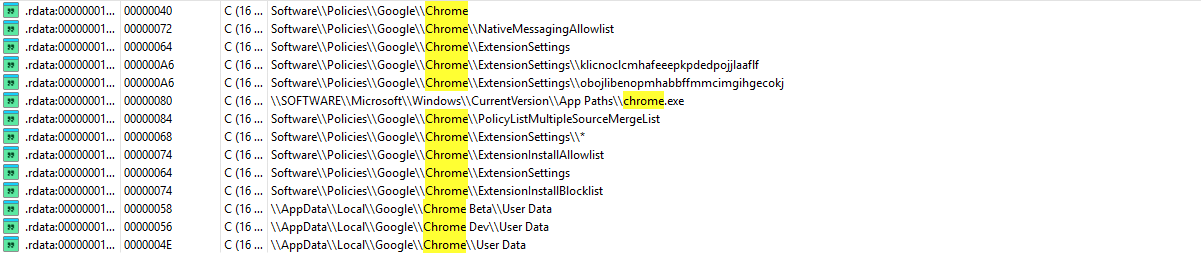
browser extension governance + credential-store monitoring.
4. ZeroTrust Assessment
%ProgramData%\CrowdStrike\ZeroTrustAssessment\data.zta a device posture/compliance score feeding conditional access. Trust scoring, a detection input (compromised/misconfigured device scores low).
5. Identity Protection the big user-mode engine
Largest user-mode subsystem, behind the RPC server. EndpointQueryActor/EndpointServer answer endpoint-enrichment queries over the CsIntegRpcServer RPC interface (UUID 88F4E894-942A-40D8-BA06-89442D8DA600). IdpPolicyManagerActor + IValueProvider<...> evaluate rules against identity/endpoint attributes; IdpMfaUiManagerActor drives the MFA prompt. Catches identity attacks pass-the-hash, Kerberoasting fallout, anomalous NTLM, lateral movement and can force step-up MFA.

Falcon Identity Threat Detection the endpoint-side actors.

the CsIntegration EndpointServer the RPC handler implementation.
6. ETW consumption + cloud content
EtwConsumer@ETW (OpenTraceW, ProcessTrace) consumes OS ETW providers to enrich telemetry. NGDP / ChannelFile (ODSChannelFileActor, ChannelFileUpdated) downloads channel files detection content/policy/IOC updates via WinHTTP and applies them at runtime. Same channel-file mechanism famous from July 2024. Cloud transport = WinHTTP.
7. The IPC architecture (and the trust model)
- Named pipes:
\\.\pipe\CrowdStrike\,\\.\pipe\CS\. - RPC:
CsIntegRpcServeronncalrpc,RPC_IF_ALLOW_SECURE_ONLY,RpcServerRegisterAuthInfoW(NTLM/Negotiate), + a security callback requiringPKT_PRIVACY.


the CsInteg RPC interface registration.

the per-call gate checks transport auth level, not caller identity (authentication without authorization
The security model is “authenticated + encrypted transport” it verifies the channel is secure and authenticates the caller, but in this callback does not restrict which users may call.
Section 8 The Decision Map (how a verdict routes)
Binary: CSAgent.sys
We’ve seen every place the sensor sees you. Now: when an event is built, how does it become a kill/allow decision?
The event is a C++-style object
The one vtable that matters is at event+32. Everything downstream talks through two calls: CS_EventGetId (event sequence ID) and CS_EventGetField (0x140378F80) a big switch(selector) returning/lazily-computing a field. The 72 / 6 / 10 / 5186 numbers are method selectors on this object.
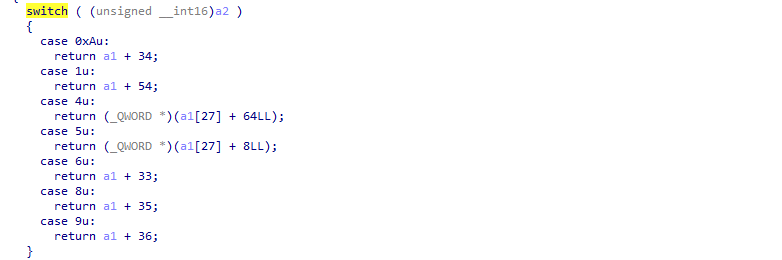
the object’s method table decoded.
Where detection ACTUALLY fires selector 72
1
2
3
4
5
6
7
8
9
case 72:
  if (!*((BYTE*)a1 + 310)) {            // not computed yet
      CS_EventGetField(a1, 10);         // force signature resolution
      CS_EventGetField(a1, 6);          // force hash resolution
      v4 = a1[21];                      // the RULE ENGINE context object
      v7 = *(*(v4) + 16);               // engine vtable slot +16 = THE MATCHER
      v10 = v7(v4, 72, id, hash, sig, a1+37);   // ← THE DETECTION CALL. verdict → event+37
      *((BYTE*)a1 + 310) = 1;
  }
That indirect call is the actual match-against-cloud-rules call. The matcher is inside the loaded content object, not in csagent. Keyed on file hash + signature + event context. 0xC0000065 (“no matching rule”) = clean, not logged.
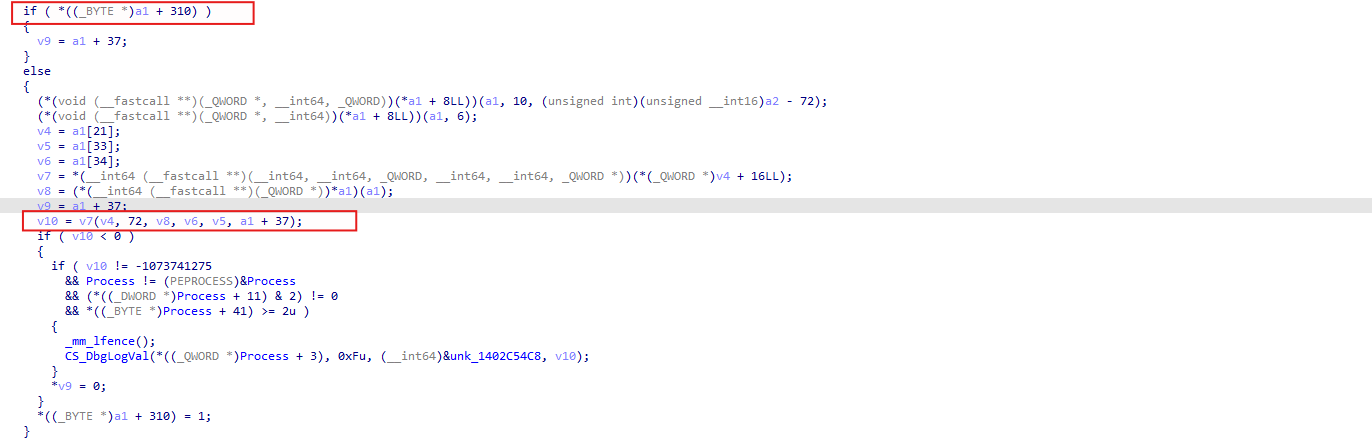
where ‘is this malware?’ gets answered.
The hash/sig gate and the bypass it creates
Full rule matching (5186) only runs when both the image hash and the Authenticode signature resolved. If either fails, the sensor logs error 14 and skips the deep match. Anything that makes hash-or-signature resolution fail (unreadable/locked image, resolution race during spin-up) drops the process into the “incomplete data” path with a weaker verdict.
The kill write-back
1
2
if ( (BYTE12(v42) & 2) != 0 )   // "block" flag set by the engine
    *v39 = DWORD2(v41);         // write verdict NTSTATUS to caller's out-param
v39is the same value copied intoCreateInfo->CreationStatus(+64). Negative NTSTATUS there = Windows aborts process creation. Block chain: engine sets bit 1 → verdict copied → written to CreationStatus → process never runs.


verdict ⇒ block chain
The injection / remote-thread tail
If not blocked, dispatch checks who created it:
1
2
3
CS_ValidateCreatorThread(FileObject, &flag);   // control code 0x86968
if (!flag)
    CS_DetectInjection(FileObject, PsGetCurrentProcessId(), PsGetCurrentThreadId(), …);  // 0x8696C
| Code | Function | Meaning |
|---|---|---|
0x86968 | CS_ValidateCreatorThread | is the creating thread a legit parent, or a hijacked/remote thread? |
0x8696C | CS_DetectInjection | full cross-process injection check |
How CrowdStrike catches process hollowing / CreateRemoteThread launches the callback fires in the injector’s context, and these codes ask the filter “does the creator match the image?”
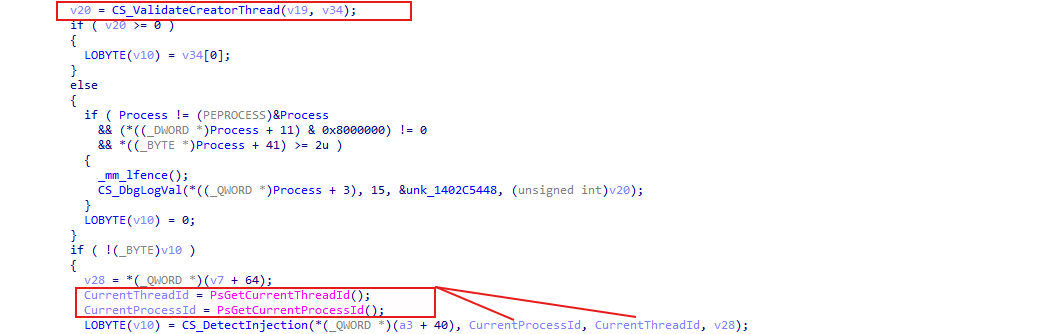
the injection-detection layer.
Section 9 The Brain (how the verdict is actually made)
Binary: CSAgent.sys
Section 8 traced the event to a single call selector 72 on the event object and stopped. This section opens that door. It’s the most architecturally important thing in the whole teardown, and it explains the July-2024 incident.
The short version
The detection rules are not in the driver. csagent.sys is a generic event-collection and dispatch framework. The thing that decides a verdict the “detection engine” is a separate object loaded into the driver at runtime from CrowdStrike content (channel files from the cloud). The driver holds it in one global pointer, g_DetectionEngine, and calls through a vtable. Update the content, and detection behavior changes with no change to the sensor binary.
1
2
3
4
5
6
7
cloud content (channel files) → CS_SetDetectionEngine(cmd 1021/2000, engineObject)
                                       │
                              g_DetectionEngine ────────────┐ (vtable call)
event happens → CS_BuildCreationEvent binds engine → a1[21] │
CS_EventGetField(event, 72) ──► engine->vtable[+16](engine, 72, hash, sig, &verdict)
                                       ▼
                                verdict ──► block / kill / allow / telemetry
1. The engine is registered at runtime, not compiled in
Walk: CS_SetDetectionEngine (0x140378360).
1
2
3
4
5
6
7
8
CS_SetDetectionEngine(a1, cmd, subcmd, engineObject):
    if (cmd != 1021 || subcmd != 2000) return STATUS_INVALID_PARAMETER;   // command gate
    if (!g_DetectionEngine) {
        g_DetectionEngine = engineObject;          // ← install the engine
        init = engineObject + 8 + *(int*)(*(engineObject+8)+4);
        (**init)(init);                            // call its initializer
        return 0;
    }
The engine arrives as a fully-formed object via the magic command pair (1021, 2000). The driver stores the pointer and calls the initializer. CS_ResetDetectionEngine (0x140378104) does the Reverse releases and nulls g_DetectionEngine so the engine can be swapped at runtime. Content-update mechanism in three functions.
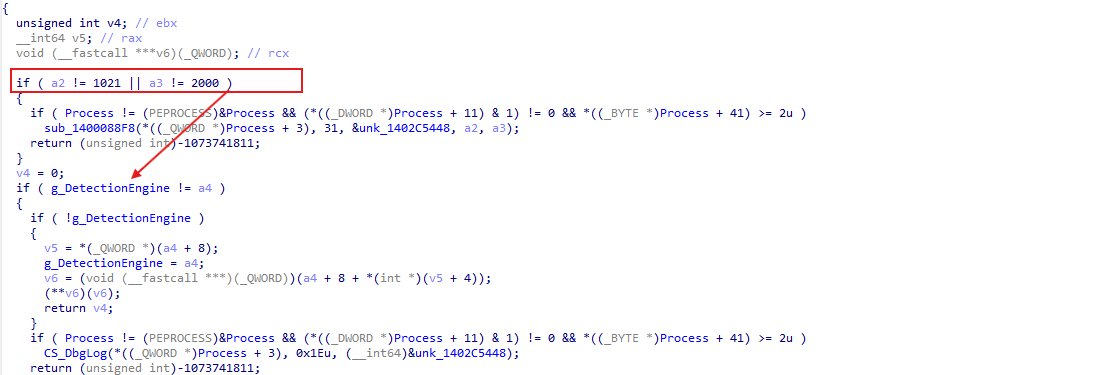
the detection engine is installed at runtime, not compiled in.
2. How the verdict call fires
1
2
3
4
5
6
case 72:                                       // in CS_EventGetField (0x140378F80)
      CS_EventGetField(event, 10);             // force signature
      CS_EventGetField(event, 6);              // force hash
      v4 = event->engineCtx;                   // a1[21]  engine, bound at build time
      match = *(*(v4) + 16);                   // engine vtable slot +16 = THE MATCHER
      verdict = match(v4, 72, id, hash, sig, &event->result);   // ★ the detection call
- The matcher is
engine_vtable[+16]a function inside the loaded content object, not in csagent. The driver has no idea how matching works; it calls slot 16 and reads a verdict. - Inputs are file hash + signature + event context.
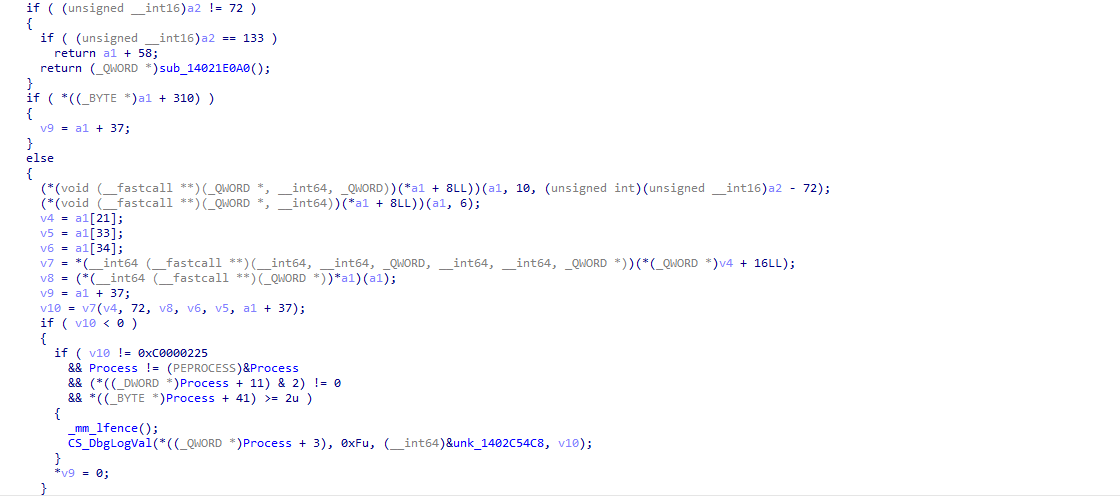
the actual malware decision a vtable call into cloud-loaded content.
3. Why this architecture matters
- Cloud-updatable detection. New IOCs/rules/signatures ship as channel files → a new engine object pushed via
CS_SetDetectionEngine. Detection improves with no sensor upgrade. - The sensor binary is nearly rule-free. Reversing csagent tells you how events are collected and how the engine is called but not what triggers a detection, because those rules live in encrypted cloud content. A deliberate limit on what static analysis can reveal.
- This is the July-2024 crash surface. The famous incident was a content (channel file) update the engine mis-processed, faulting inside this exact path a bad rule object pushed into
g_DetectionEngine, not a code bug in the sensor. The architecture that makes detection updatable is the same one that made a bad content push global.
Mental model: csagent.sys = eyes + hands (see events, apply verdicts); the loaded content engine = the brain (decide). The brain is swappable, cloud-delivered, and absent from the binary.
Section 10 Blind Spots & Evasion Seams
Synthesis structural observations from the code, not tested exploits. Reuse earlier screenshots (O1/O2, W1, E1, R1).
Every seam the teardown surfaced, collected in one place:
| # | Seam | Where | Consequence |
|---|---|---|---|
| 1 | ExGetPreviousMode() trust boundary | Object (O1/O2) + Registry (R1) callbacks | Object/Registry filters only fully act on user-mode callers. A kernel-mode actor (another driver, or an in-kernel exploit) opening a handle or touching the registry is largely unfiltered. The single biggest structural assumption in the driver. |
| 2 | NULL engine / config-not-ready | CS_DetectionDispatch gates 2–3, CS_SetDetectionEngine (E1) | If g_DetectionEngine == NULL (early boot before content loads) or *(g_SensorConfig+56)==0 (rules still loading), dispatch passes everything unmatched. CS_ResetDetectionEngine nulls it. Delay/prevent engine registration = a window where the world’s best rules aren’t consulted. |
| 3 | Hash-or-sig resolution failure | selector-72 gate (D2/E2) | Full rule match (5186) skipped when hash or signature fails to resolve the most practical software-side gap (locked/unreadable image, spin-up race). |
| 4 | IRQL / APC / registration windows | thread (T1), image (I1-3), file (F1) | Thread callback bails at raised IRQL / APCs-disabled. Minifilter has an explicit “registering” state (2). Early-boot / just-mounted-volume I/O is unfiltered. |
| 5 | Config-gated detectors | byte_1402FB824 (remote-thread), g_TraceEnabled, CS_IsSensorEnabled()→0 | Before policy lands or if a flag is clear, specific detections are silently off. |
| 6 | 10,000-flow cap | CS_FlowEstablishClassify (W1) | Past 0x2710 tracked flows, new connections aren’t tracked (untracked = not reset-killable). Reachability is a dynamic question, but it’s a hard ceiling. |
| 7 | Reset-based kill is racy | CS_KillFlaggedFlows (W2/W3) | Termination is a TCP RST injected after a verdict. Short-lived flows (a quick beacon) may complete before the reset lands. Mitigation after detection, not prevention. |
| 8 | DPI sees a copy | FwpsCloneStreamData0 | Classic DPI evasions (segmentation, out-of-order, TLS) limit payload matching. Encrypted C2 is opaque only metadata/JA3-style signals remain. |
| 9 | Self / exclusion allowlists | CS_IsExcludedProcess, Ob self-access, registry recursion guard | “Trusted” contexts. Enumerating what’s trusted = finding the gaps. |
| 10 | Static fingerprints | WFP callout GUIDs, FLT altitude, Ob/Cm altitudes, pool tags (Tes1/Tes2, PdPp, CSFR) | All enumerable (netsh wfp show state, fltmc filters, !poolused) confirm the sensor and its coverage before acting. |
| 11 | Content-driven = binary can’t reveal rules | g_DetectionEngine (Section 9) | Evasion by “reading the binary for the rule” doesn’t work the rule isn’t there. You’d need the decrypted channel content. The framework gates are in the binary; the rules aren’t. |
| 12 | In-kernel parsers on attacker data | PE headers (I2), stream payloads, file-name info | Parse/allocation bugs here would be high-value the memory-safety attack surface. |
So end to end
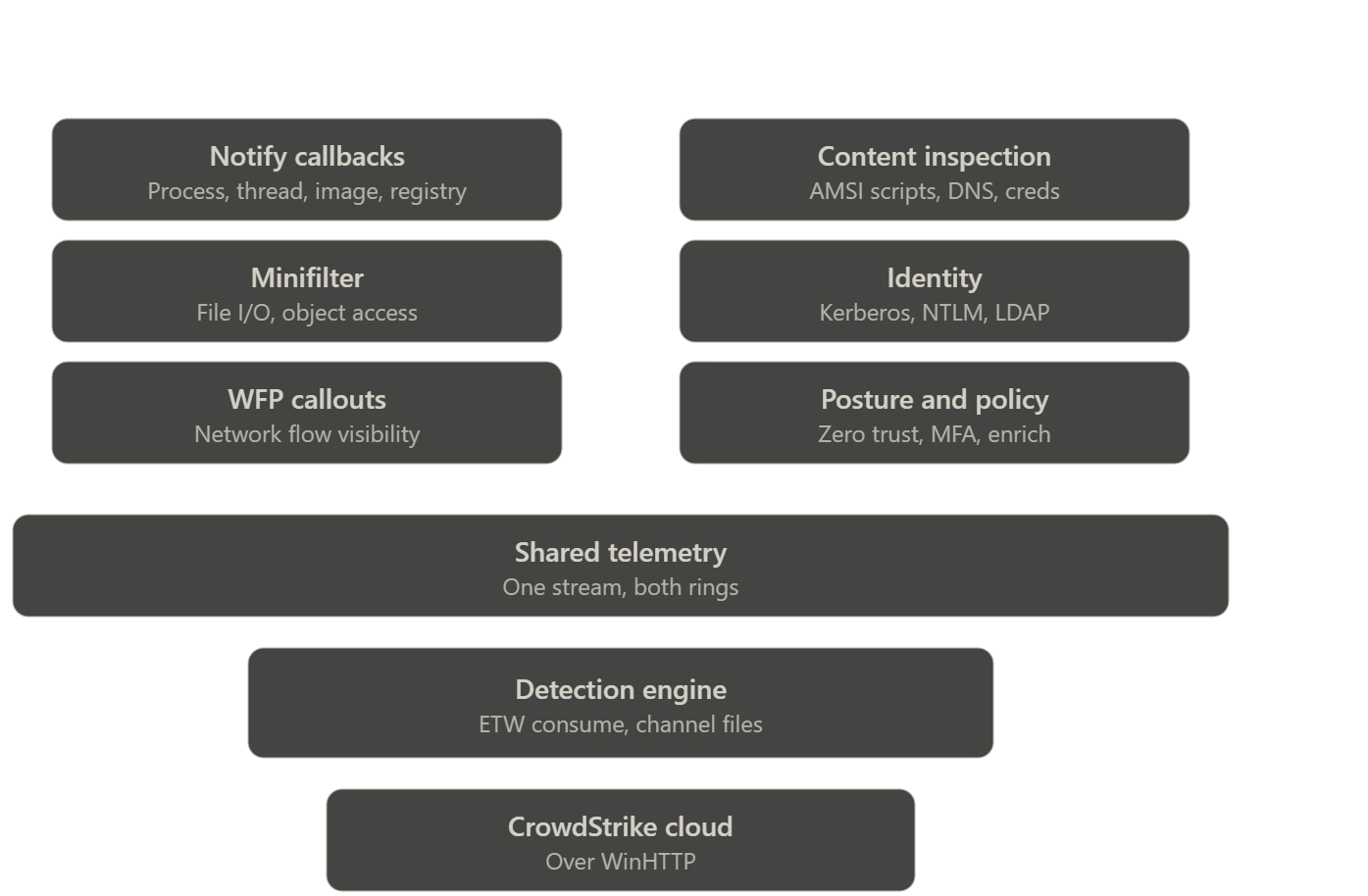
Appendix Function Rename Map
CSAgent.sys
| Address | Name | Role |
|---|---|---|
| 0x140377450 | CS_DetectionDispatch | the decision function |
| 0x14037889C | CS_BuildCreationEvent | 552-byte creation event builder |
| 0x140379454 | CS_BuildTerminationEvent | 344-byte termination event builder |
| 0x140378F80 | CS_EventGetField | event object selector dispatcher |
| 0x14001FAB0 | CS_EventGetId | returns event sequence id |
| 0x140378360 | CS_SetDetectionEngine | installs the runtime engine (cmd 1021/2000) |
| 0x140378104 | CS_ResetDetectionEngine | tears down / swaps the engine |
| 0x140378704 | CS_DetectInjection | cross-process injection check (0x8696C) |
| 0x140099DF0 | CS_ValidateCreatorThread | creator-thread legitimacy (0x86968) |
| 0x1400C4784 | CS_RefProcessRecord | refcount++ on record |
| 0x1400C4DA0 | CS_ResolveProcessImageInfo | lazy image-path field |
| 0x1400C4DF8 | CS_ResolveProcessCmdInfo | lazy command-line field |
| 0x1400C4F78 | CS_GetProcessTokenInfo | SID / integrity resolver |
| 0x1400CFE50 | CS_ThreadCreateCallback | thread create/exit callback |
| 0x1400D190C | CS_DetectRemoteThread | remote-thread check |
| 0x1400B03A0 | CS_LoadImageCallback | image/DLL/driver load |
| 0x1400B1CB8 | CS_HandleDriverLoad | driver-load path (BYOVD) |
| 0x1400C20D0 | CS_ObPreOpCallback | handle pre-op filter |
| 0x1400C2234 | CS_CheckHandleAccess | access-mask decision (LSASS shield) |
| 0x1400C7790 | CS_RegistryCallback | registry filter |
| 0x14020DE50 | CS_RegisterCallouts_Eng1 | WFP callouts → engine 1 |
| 0x14021E738 | CS_RegisterCallouts_Eng2 | WFP callouts → engine 2 |
| 0x1400B5DF0 | CS_FlowEstablishClassify | allocates CSFR flow record |
| 0x1401D108C | CS_KillFlaggedFlows | enumerates flagged flows |
| 0x1401D626C | CS_ResetFlow | injects a TCP reset |
| 0x1401D4260 | CS_InjectTransportPacket | transport/stream injection (C2 kill) |
| 0x1403630B0 | CS_RegisterMinifilter | FltRegisterFilter + arm |
| 0x1403622A0 | CS_FltPreCreate | pre IRP_MJ_CREATE |
| 0x14009E2F4 | CS_HandleFileSetInfo | delete/rename handler |
| 0x1400A2834 | CS_HandleFileCreate | CREATE handler |
Globals: g_DetectionEngine 0x140515060 · g_SensorConfig 0x140515030 · g_TraceEnabled 0x1402FA081 · g_WfpEngine1 0x1402FB328 · g_WfpEngine2 0x1402FB370 · g_CalloutTable 0x1402F9A48
cspcm4.sys
| Address | Name | Role |
|---|---|---|
| 0x180001470 | DllInitialize | rendezvous / init |
| 0x180001010 | Pcm_BrokerCallback | hands out shared context |
| 0x1800010A0 | Pcm_RegisterCallbackSlot (ord 802) | 16-slot callback registry |
| 0x180001400 | Pcm_ReadPinnedPage (ord 803) | read pinned 4 KB page |
| 0x180001340 | Pcm_InitApc (ord 806) | APC injection init |
| 0x180003480 | CS_MemMove | SSE memmove (page copy) |
CSFalconService.exe
| Address | Name | Role |
|---|---|---|
| 0x1405B2FF0 | Cs_RpcServerStart | registers the CsInteg RPC interface |
| 0x1405B3380 | Cs_RpcSecurityCallback | per-call RPC security check |
X : 0xDbgman